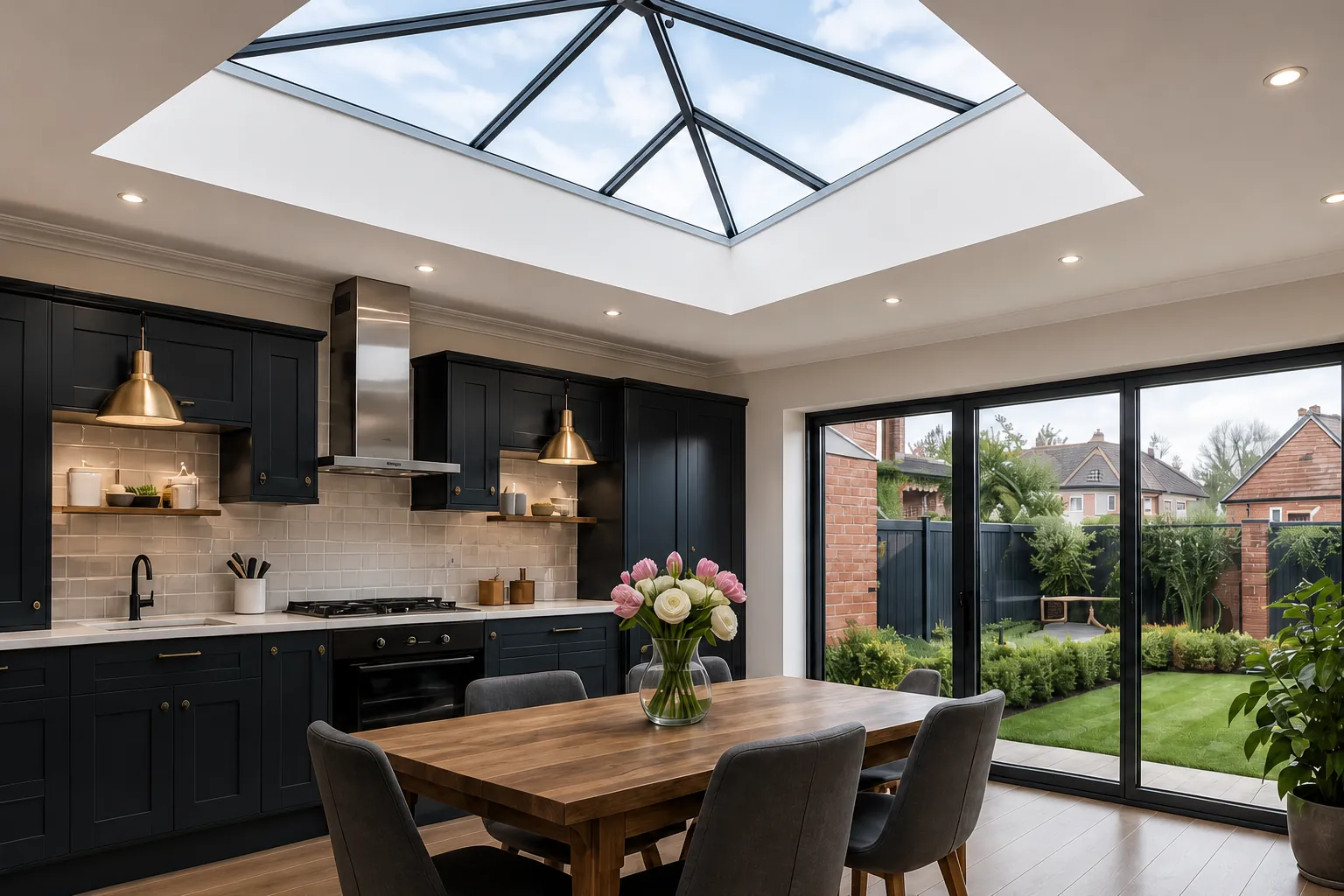

A lantern is only as good as the kerb it sits on.
We build every lantern on a level, insulated kerb with the right falls around it, so rain runs away from the frame and the joints stay airtight.
Inside, we plaster the kerb lining, square the corners and make good the ceiling around it, so the room looks finished the day we leave.
- Installed
- Replaced
- Made good inside
Which lantern suits your extension
Ridge lantern
Rectangular, with a ridge along its length. Suits long kitchen-diners and rear extensions.
Pyramid lantern
Square, with four hipped sides meeting at a point, for even light in a square room.
Low-profile lantern
A shallow pitch and slim bars for a modern look, with less to see from the garden.
The Spire guide to roof lanterns
Roof lanterns in Coventry: the kerb, the glass and the ceiling
A roof lantern is often the largest piece of glass a house puts into a roof, and the one where the work underneath matters most. This guide follows a lantern from the flat roof outside to the finished ceiling inside, so you know what to ask for before anyone quotes.
01 Natural light from above
Why a lantern lights the middle of a deep room in a way a wall window cannot.
On the roof
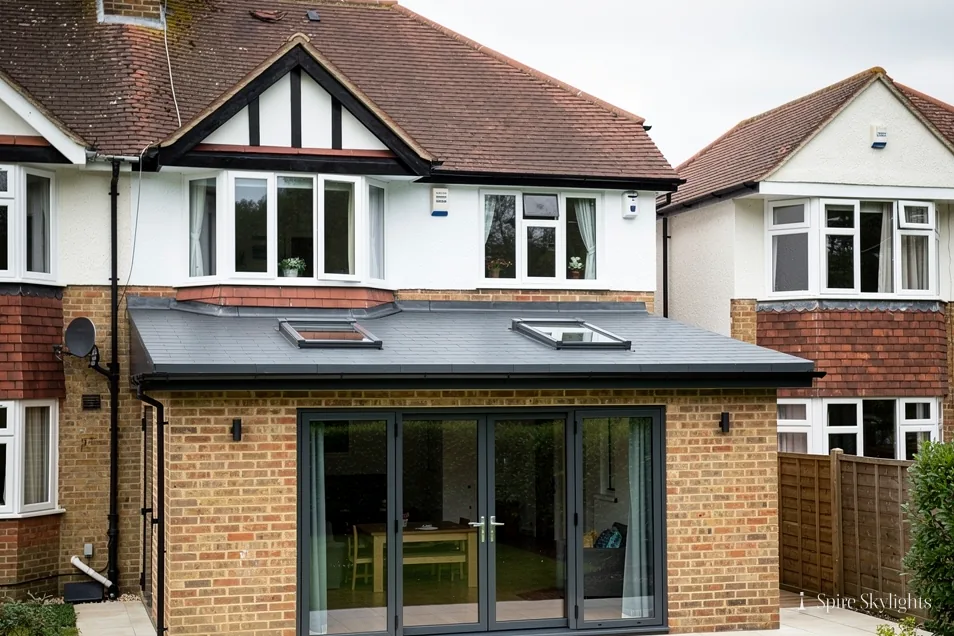
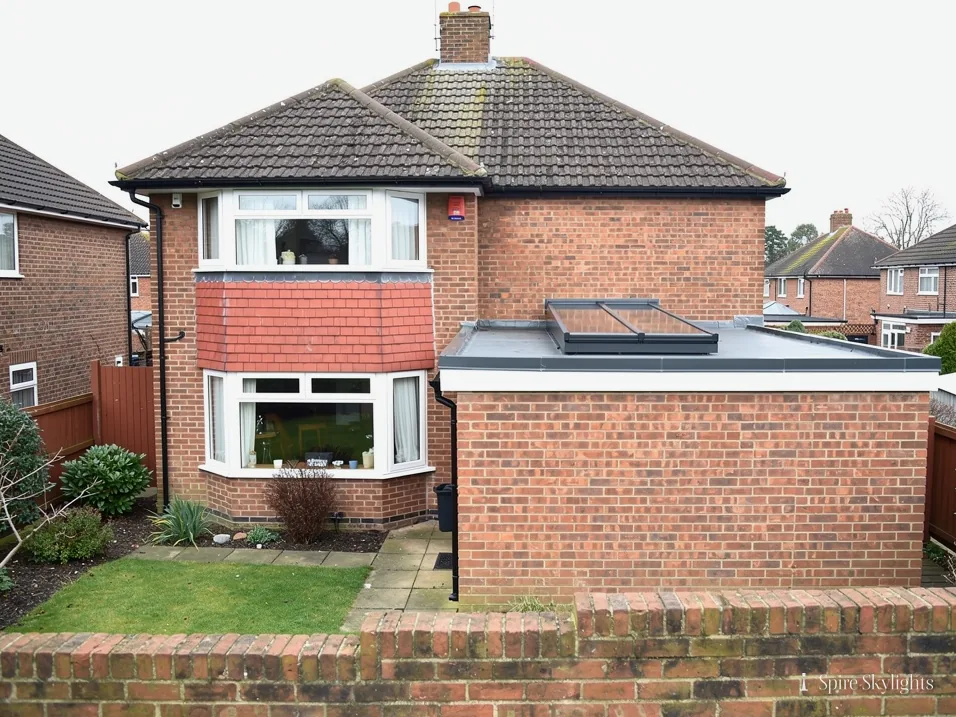
Roof lanterns in Coventry suit single-storey rear extensions: a kitchen-diner behind a 1930s semi, a garden room off a Victorian terrace, the orangery with a flat perimeter roof and glass in the middle. In each case the lantern is a rooflight with a raised, pitched glass top, made bespoke to its opening and built up from a timber kerb on a flat roof.
That raised shape is the point of it. A flat rooflight sees the sky through one pane. A lantern has glazed slopes on every side, so it gathers daylight from more of the sky as the sun moves round the house. On a dull morning it collects what light there is from overhead, and on a bright afternoon its slopes catch sunlight at a lower angle than a flat pane could.
A lantern needs a flat roof to stand on. Where the roof slopes, the answer is usually roof windows set into the pitch, and where you want a lower line on the roof, a flat roof rooflight does the job well. Our guide to choosing between a roof lantern and a flat rooflight sets the two side by side.
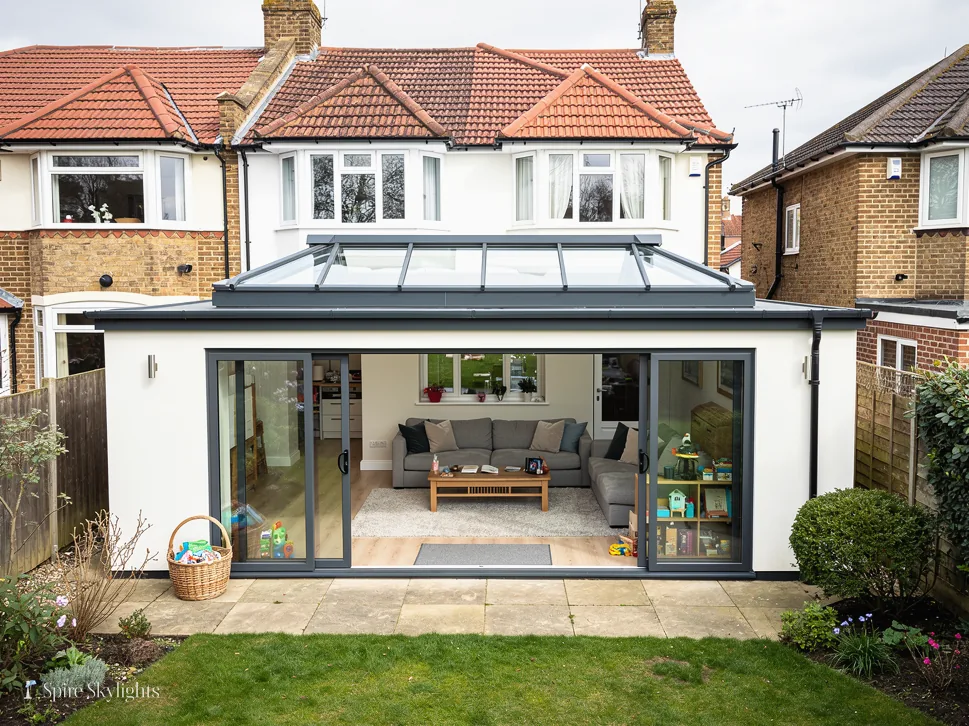
In the room
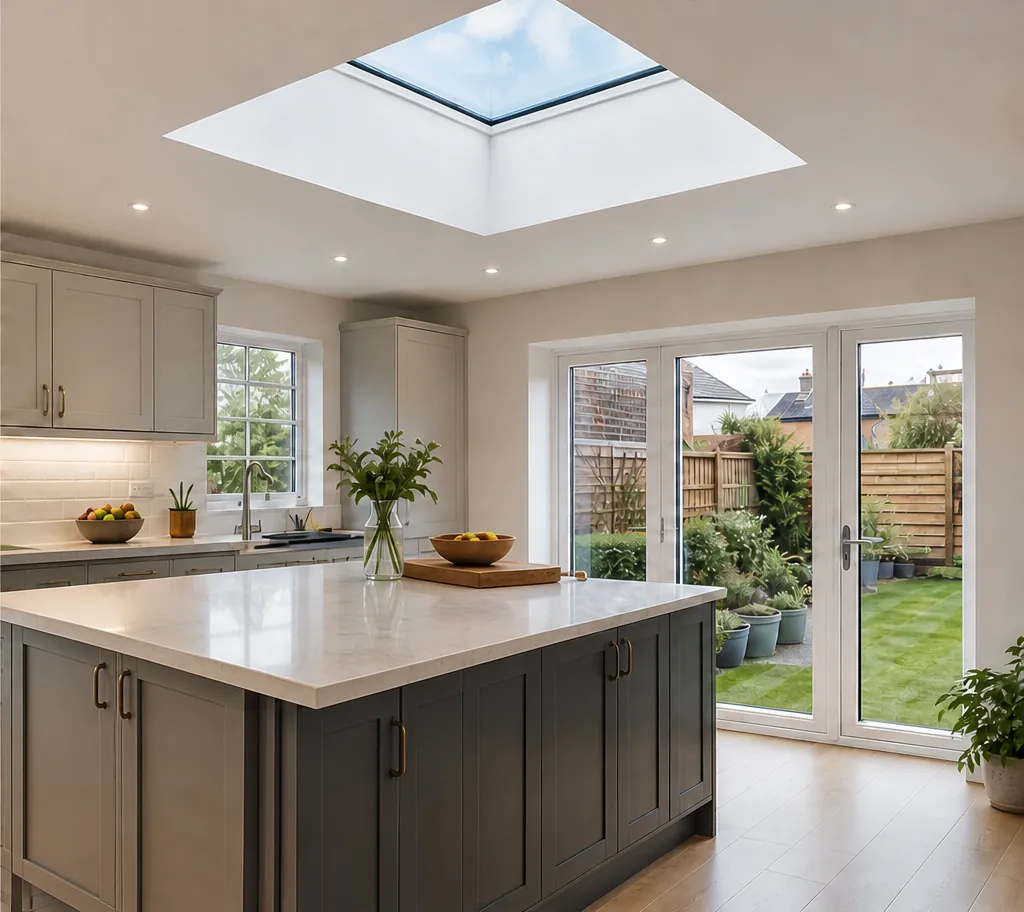
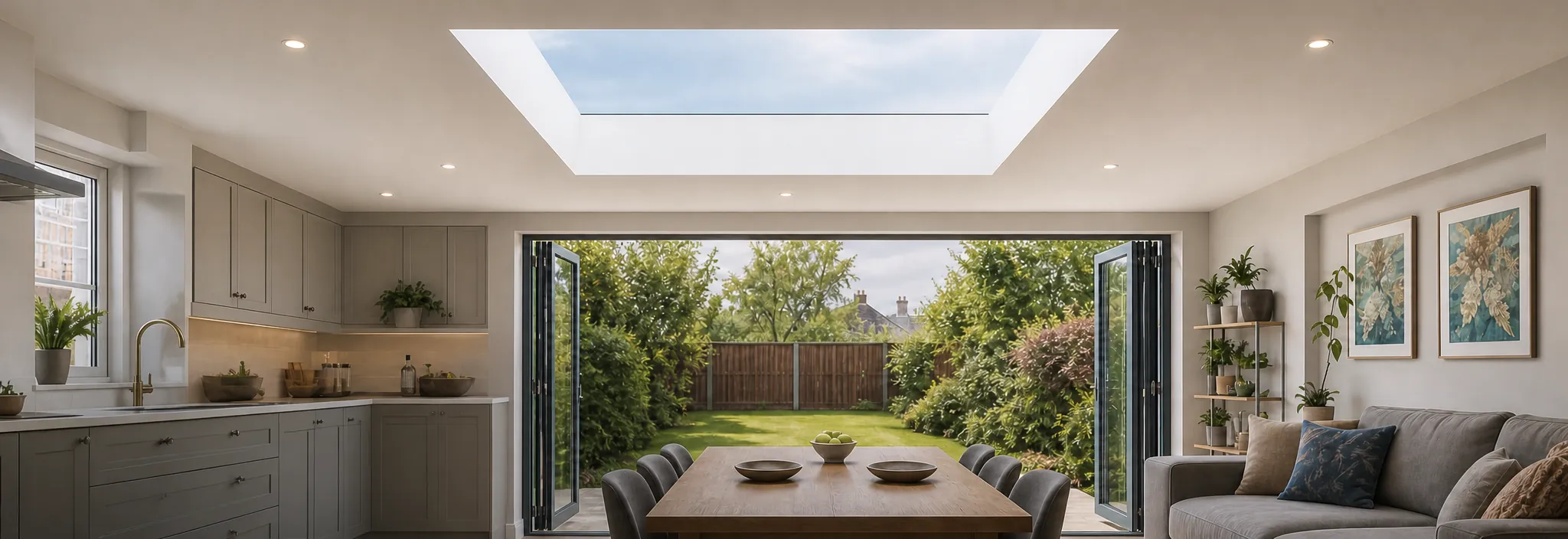
A deep extension has the same problem in nearly every house. The doors at the garden end are bright, and the middle of the room, where the new kitchen meets the old back wall, sits in shade. A window in a wall only throws light so far into a room. Natural light from above falls straight down into the part the walls cannot reach.
So where the lantern goes matters as much as how big it is. We set it over the place you use most, usually the dining table or the island, and keep it clear of the wall line so the light lands on the room rather than down a stretch of plaster. If a steel beam or the line of the old back wall sits where the lantern ought to go, we say so at the survey and show you the options on a drawing.
A skylight of this kind changes how the room behaves through the day. Morning light arrives sooner, the ceiling lights go on later in the evening, and on a grey winter afternoon the table under the glass is often the brightest place in the house.
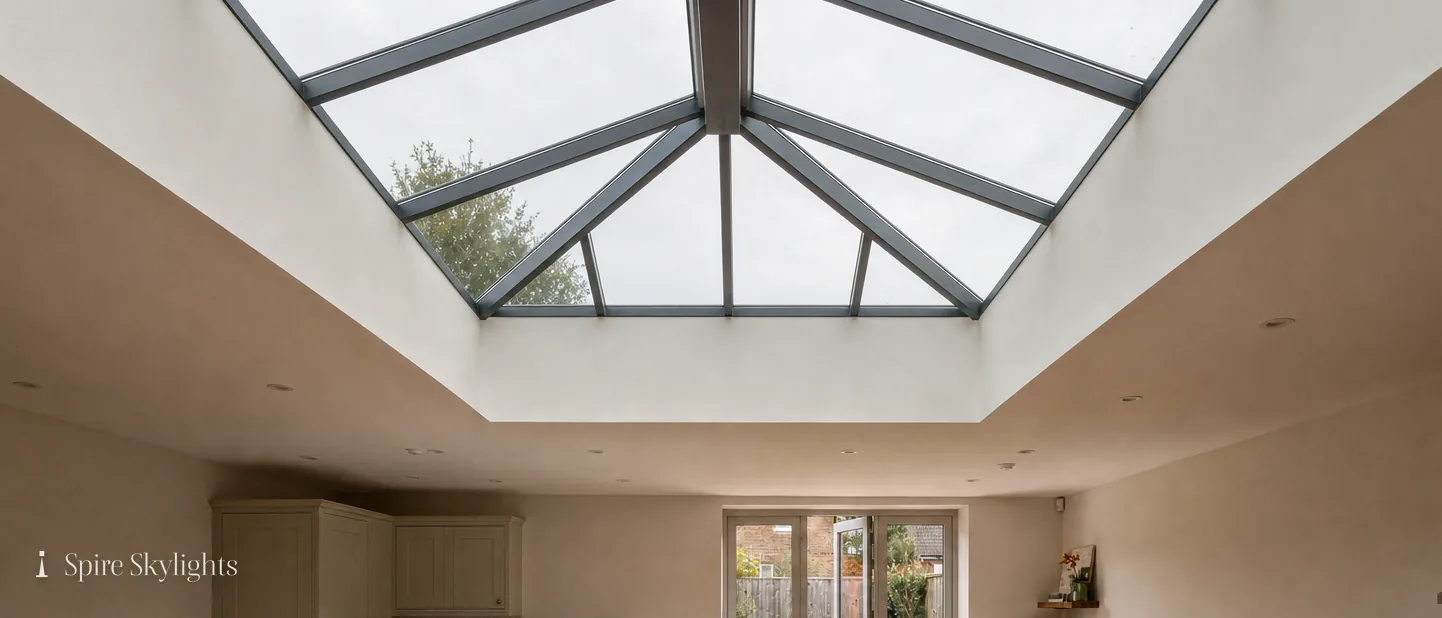
Windows light the edge of a room. A lantern lights the middle of it.
02 Types and styles of lantern
Ridge, pyramid, low-profile or octagonal: the shape follows the room.
On the roof: shapes and styles
The shape of a lantern follows the shape of its opening. A long, rectangular opening takes a ridge lantern, with glazed hips at each end and a ridge running between them. A square opening takes a pyramid, four sloping sides meeting at a point. A low-profile lantern keeps the same idea with a shallower pitch and slimmer bars, so less of it shows above the parapet when you look back from the garden.
Octagonal lanterns, and others with more facets, belong to orangeries and to older houses where a traditional look sits well. They can look right on a Regency villa in Leamington Spa or a Victorian house with a deep garden room, and out of place on a crisp rendered box.
Every style comes as a fixed lantern or with opening vents. A vent sits in one of the glazed slopes and opens by a winding pole or an electric motor, often with a rain sensor that closes it when the weather turns. We build the kerb to suit the style you choose, so the frame sits square on it with nothing forced into place.
In the room
From inside, each style draws a different shape on the ceiling. A ridge lantern makes a long, bright strip that suits a kitchen-diner running from the house to the garden. A pyramid gives a square, centred pool of light, the right choice over a dining table or a square family room. A low-profile lantern looks calm and modern from below, with fewer bars crossing the sky.
The bars matter. Every glazing bar is a line across your view of the sky, so slimmer sightlines read as more glass and less frame. We show you the bar layout of each lantern on the drawing before you choose, so there is no surprise the first time you look up.
Think too about what is above and around it. A lantern under a tree collects leaves and shade on the glass, and a lantern overlooked by an upstairs window becomes part of the view from the bedroom. Both are worth a few minutes at the survey, because both can change the style or the glass that suits you best.
| Style | Shape | Suits | From below |
|---|---|---|---|
| Ridge | Rectangular, hipped at both ends | Long kitchen-diners and rear extensions | A long strip of light |
| Pyramid | Square, four sloping sides | Square rooms and space over a table | A centred pool of light |
| Low-profile | Shallow pitch, slim bars | Modern extensions with a parapet | Fewer lines across the sky |
| Octagonal | Eight facets around a centre | Orangeries and period houses | A traditional crown of glass |
The short version
Choose the shape from the plan of the room, then the style from the house around it.
03 Sizes, bespoke and the opening
How big a lantern can be depends on the roof under it, not the catalogue.
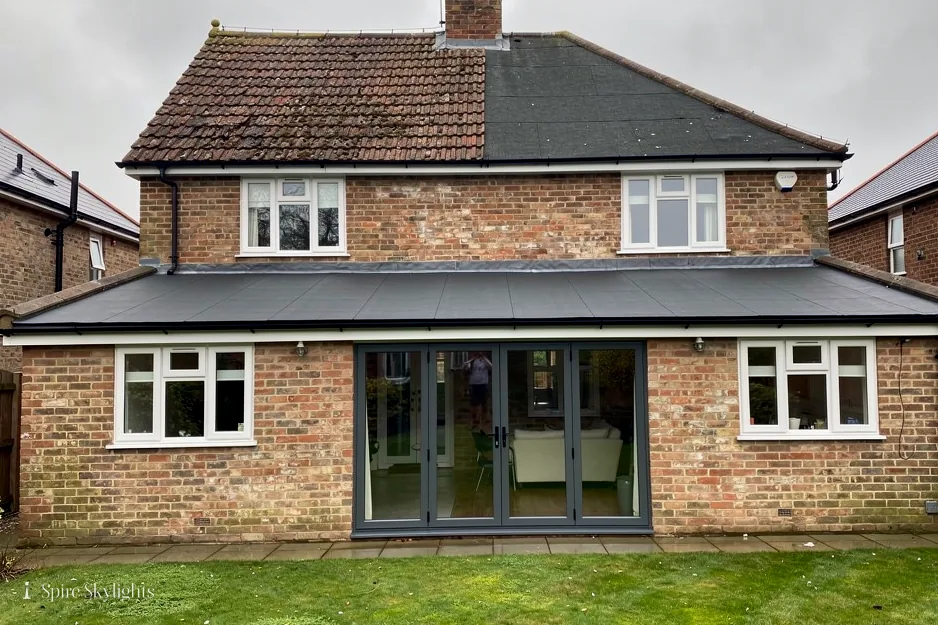
On the roof: the structure
Every lantern we fit is bespoke, made to the size of its kerb rather than picked off a shelf. That makes the question how big an opening the roof can take. Each maker sets a largest size for each style, and a big lantern on a well-framed new extension can come close to it. On an older flat roof, the joists decide.
Cutting an opening means cutting joists. The cut ends are carried on new trimmer joists either side, and on a wide opening the trimmers or a beam are sized by a structural engineer. That work alters the structure of the roof, so it falls under the Building Regulations, and we handle the Building Control notification as part of the job. Our answer on whether a rooflight needs Building Regs sets out when it applies.
On a new extension, the opening belongs on the drawings from the start, with the trimmers built in while the roof goes on. We are happy to talk to your builder or architect early, so the opening, the kerb and the lantern size line up before the roof deck is laid.
In the room: sizing to the space
Size in the room is about proportion. A lantern too small for a long kitchen looks like an afterthought. One that fills almost the whole ceiling leaves no space for lights, a cooker hood or a beam, and can make the room feel like a conservatory. Our answer on what size roof lantern you need walks through how to judge it for your own room.
We measure the room and the roof on the same visit, because the two sizes have to agree. The size you see from the garden is the frame. The size you see from inside is the kerb opening, plus whatever splay the lining can take. We mark the lantern on a ceiling plan beside the lights, the hood and the main furniture, so you can see where the light will fall before anything is ordered.
Where downlights, a cooker hood or a speaker sit near the planned opening, we plan around them now rather than move them later. It is far easier to place a light fitting a little to one side on paper than to patch a ceiling after the event.
Measure the room and the roof on one visit
Check the joists, their direction and their depth
Agree the opening size and the lantern style
Confirm the maker's sizes and the glass specification
Set the size, the style and the price out in a fixed written quote
04 The kerb and the seal
Weatherproof outside and square inside: everything starts with the base.
On the roof: weatherproof from the kerb up
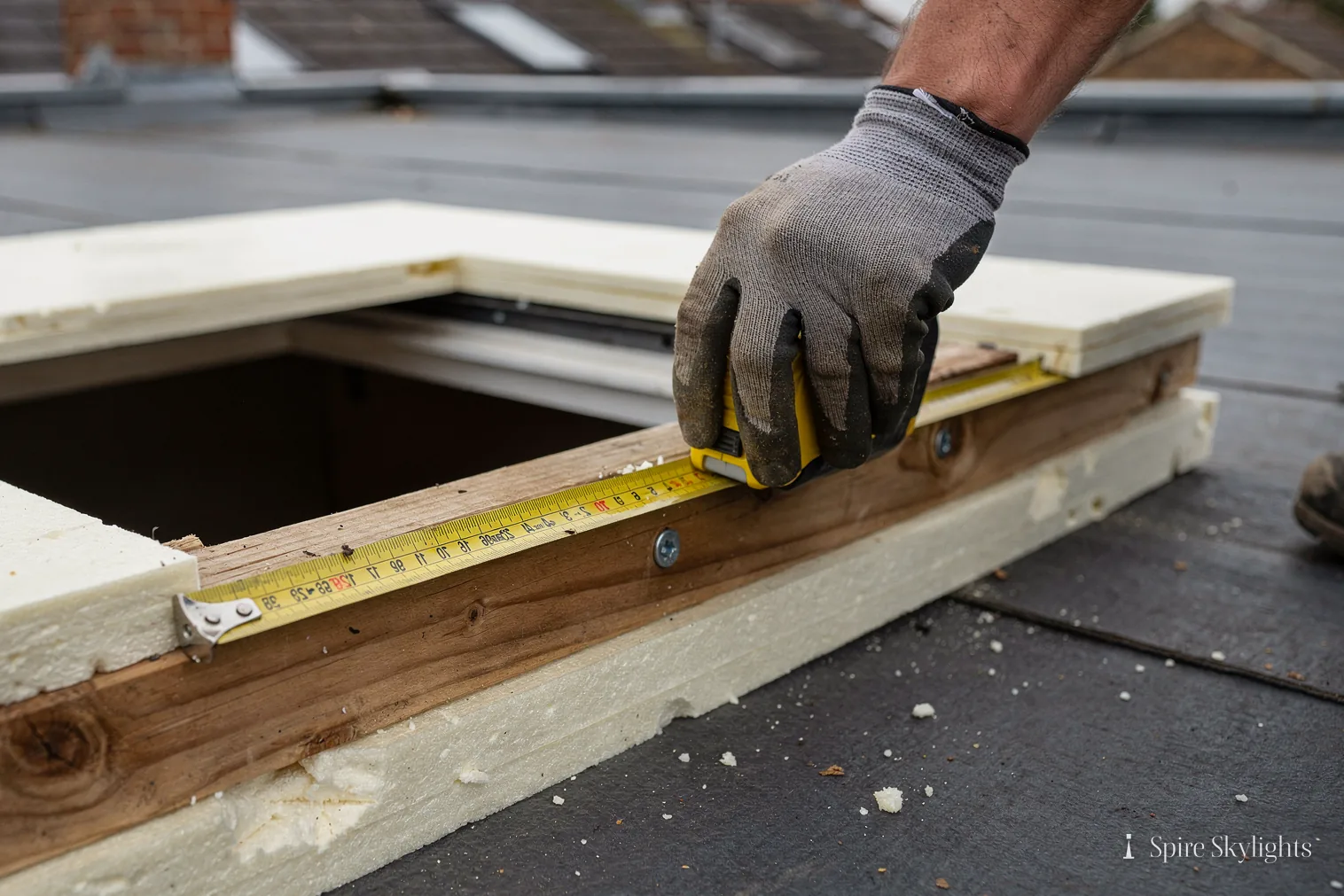
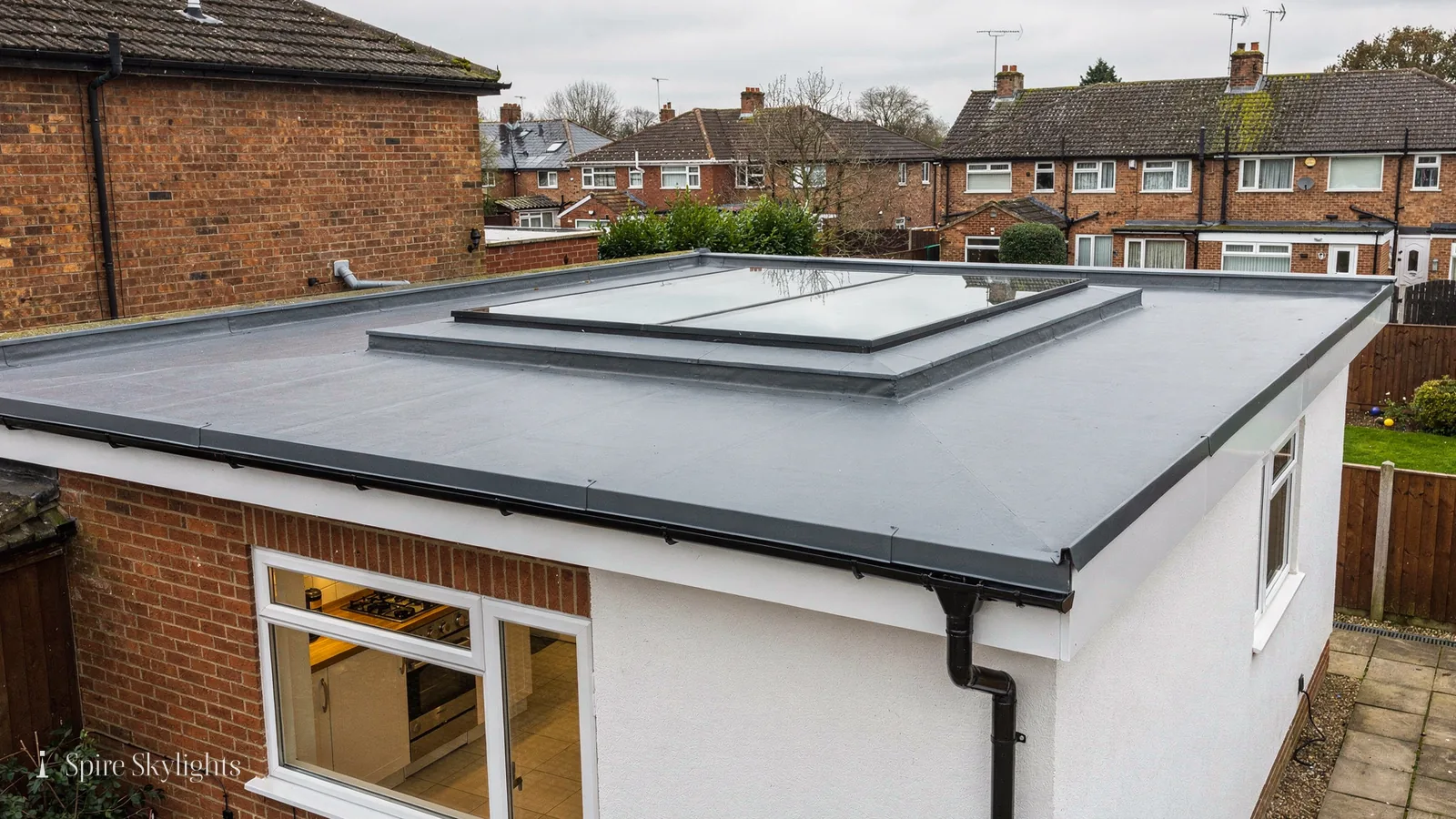
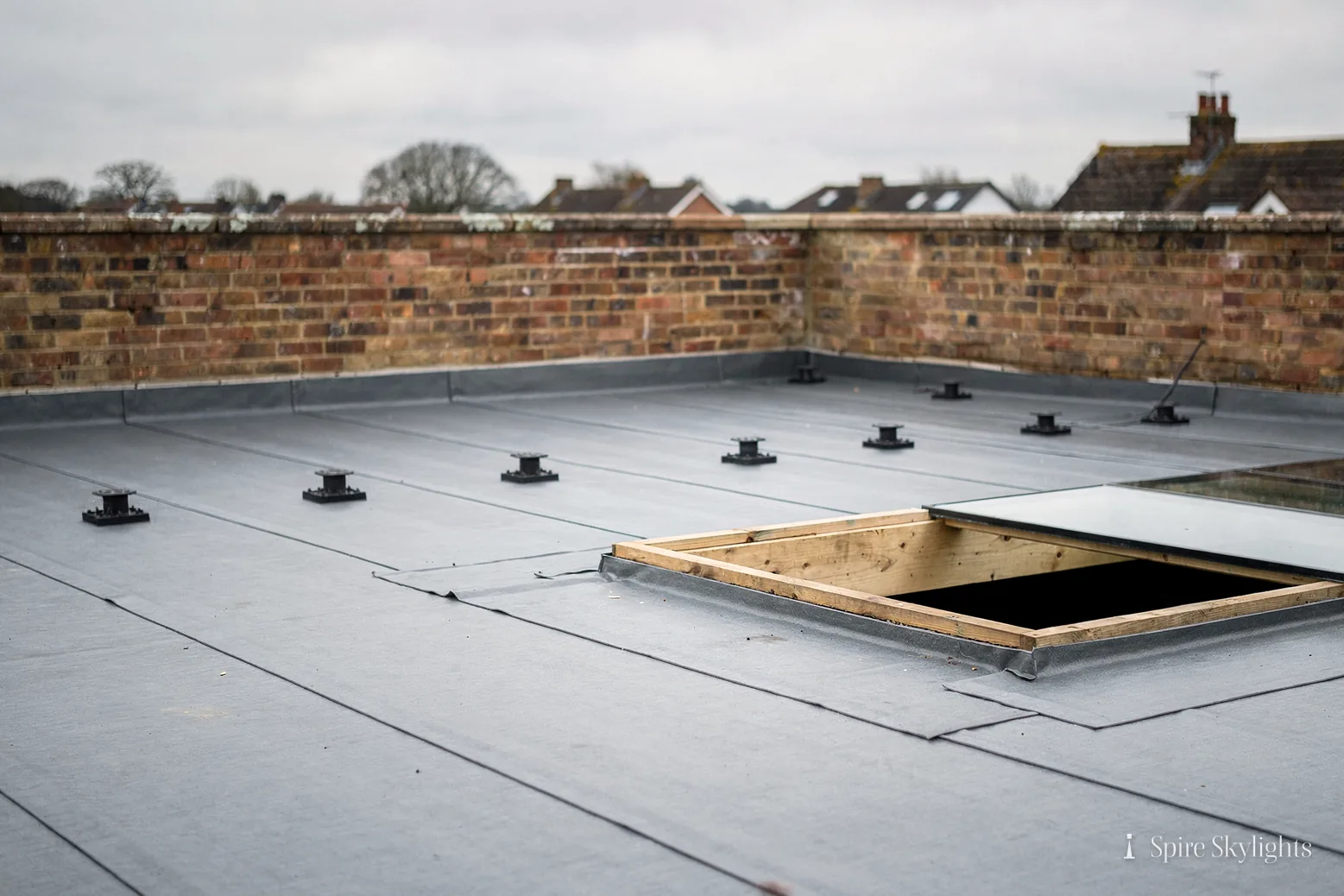
The kerb is the upstand the lantern sits on, and it does two jobs. It lifts the frame clear of the roof so water never stands against the joint, and it gives the lantern a level, square base to fix to. The usual flat-roof detail calls for an upstand of at least 150 mm above the finished roof surface, and a lantern frame will not pull a twist out of a kerb that is out of level.
We build the kerb in timber to the exact size of the opening, insulate it, and dress the roof covering up its sides and over the top before the lantern goes on, whether the roof is felt, single-ply or a liquid membrane. The frame is then fixed down to the kerb against the wind and sealed to it, so the whole lantern is weatherproof from the membrane to the ridge.
When a lantern leaks, the cause is usually at this detail rather than in the glass: a kerb built too low, a membrane stopped short of the top, or water ponding against the upstand because the roof around it has no fall. We correct the fall around the kerb so rain runs away from the frame. Our answer to whether roof lanterns leak goes through the usual causes in turn.
In the room: the lining

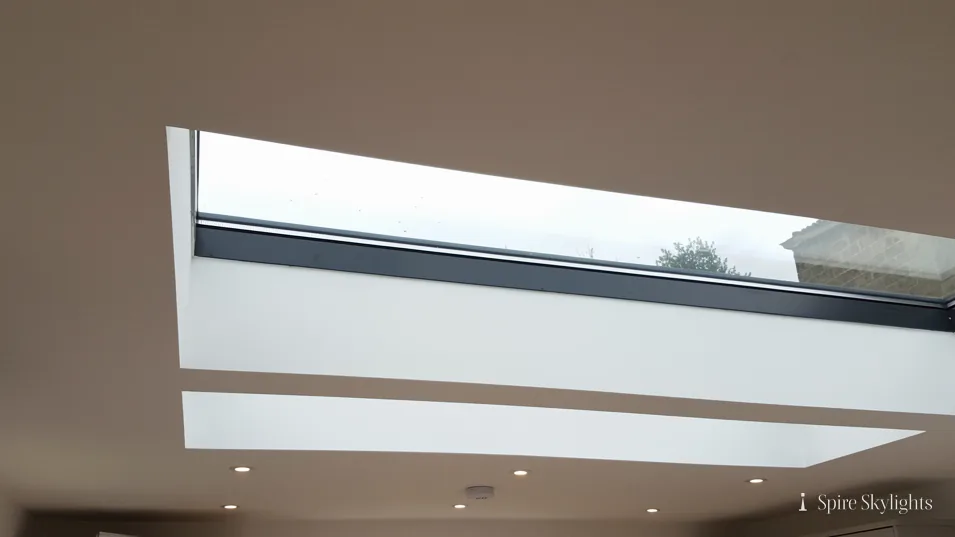
From inside, the kerb becomes a deep box between the ceiling and the glass. Left as bare timber or a quick sheet of board, it is the first thing the eye catches when you look up, and its cold edges are where condensation forms on a winter morning.
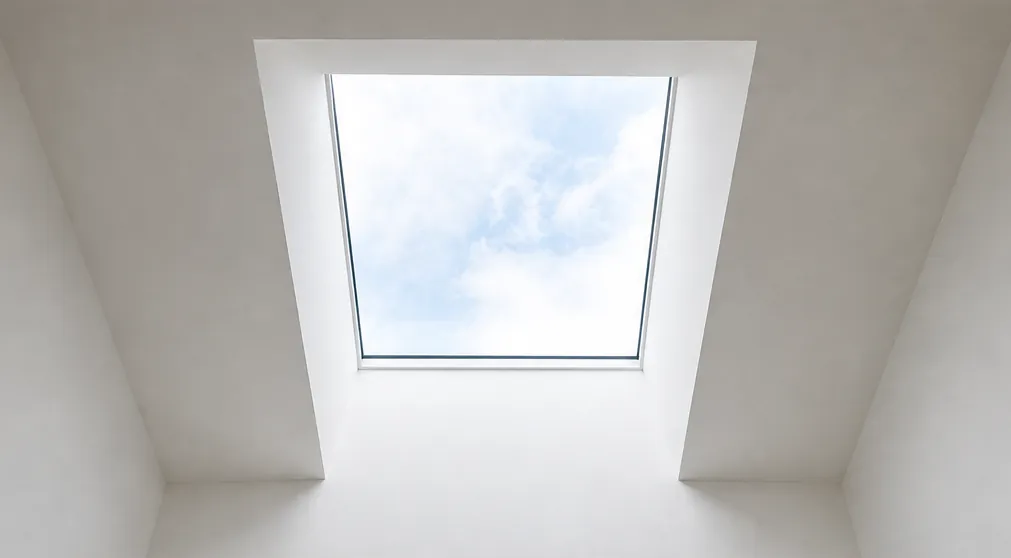
We line the kerb with insulated plasterboard, fit beads to every corner and plaster it to the same finish as the ceiling, so the lining reads as part of the room. Where the roof depth allows, we splay the lining outwards towards the room, so the light leaves the kerb wider than it entered and spreads further across the floor below.
The insulation in the lining keeps the inner face of the kerb warm, and a warm surface is what stops it streaming in a steamy kitchen. Good ventilation does the rest: an extractor over the hob, and an opening vent in the lantern if you want one. This is what we mean by a lantern finished inside and out.
How far the light goes
A narrow pool of light
Straight reveal
Light across the room
Splayed reveal
The short version
A level kerb, a sealed upstand and a plastered lining are what make a lantern look built in and stay dry.
05 Frames, materials and finishes
Aluminium or uPVC, one colour or two, and what each looks like from below.
On the roof: frames and materials
An aluminium roof lantern has a frame of extruded aluminium sections with a thermal break, an insulating barrier inside each section that stops the cold outer face conducting straight through to the room. Aluminium is strong for its size, so the bars and rafters can stay slim and the frame can span a large opening without bulky sections. It is powder coated in the factory, which gives a hard, even finish that copes well with the weather.
A uPVC lantern is built around uPVC sections, usually with aluminium cappings on the outside and sometimes an aluminium core to stiffen the rafters. The bars tend to be wider than aluminium ones over the same span, and the colour choice is narrower. For a smaller lantern on a modest extension it can be a sensible choice.
Whichever you pick, the frame is only part of the story outside. What keeps a lantern weatherproof is the kerb under it and the seals between frame and glass, and those we check on every lantern before we leave the roof.
In the room: colour and finish
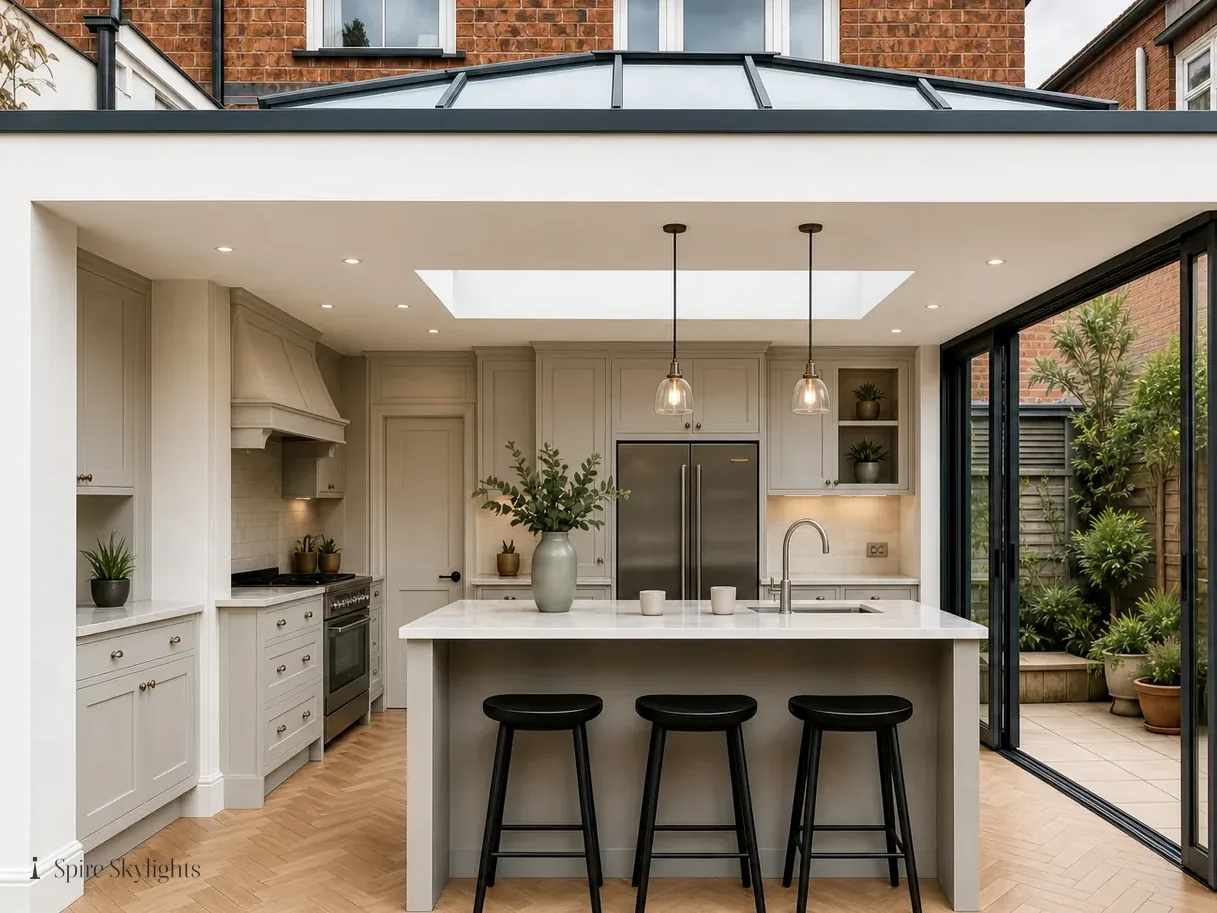
Inside, the frame becomes part of the ceiling. White is the quiet choice, letting the bars fade against a white lining. Dark grey or black bars frame the sky like a picture, which suits a modern kitchen with dark window frames or bifold doors. Aluminium lanterns can often be dual colour, one shade outside to match the doors and another inside to suit the room.
The internal finish matters too. Some lanterns have a decorative cornice around the inside of the frame or a boxed ridge, and others keep the inside plain with clean lines from kerb to ridge. We show you the inside detail of each lantern, not only the outside, before you decide.
Whichever finish you choose, the bars should line up with something in the room: the island, the table, the run of the kitchen units. We set the lantern out so its ridge runs with the room rather than across it, unless the roof structure points the other way.
| Point | Aluminium | uPVC |
|---|---|---|
| Frame | Thermally broken aluminium sections | uPVC sections, often with an aluminium core |
| Bars and sightlines | Slim, even over a large span | Wider over the same span |
| Outside finish | Factory powder coating | uPVC with aluminium cappings |
| Colour | A wide range, in one or two colours | A narrower range |
| Best suited to | Large openings and modern extensions | Smaller lanterns on modest extensions |
Choose the frame you will be happy looking up at every day, because from the room it is the frame you see.
06 Glass, heat and thermal performance
Plenty of daylight without a greenhouse in July or a cold spot in January.
On the roof: the glass
Lantern glass comes as sealed double or triple glazed units. Because the glass is overhead, the inner pane is laminated, so if it ever breaks the pieces stay bonded to the interlayer, and the outer pane is toughened to take hail, wind and snow. The cavity between the panes is gas filled and closed with a warm edge spacer, which keeps the edges of the glass warmer and cuts down the condensation that forms there.
Coatings do the rest. A low-emissivity coating holds heat in the room. A solar-control coating on the outer pane reflects much of the sun's heat while still letting the daylight through, and is worth having on a lantern that faces south or west. A self-cleaning coating on the outside helps rain wash dirt away, so the glass stays clean for longer between rinses. Lantern glass is made for weather rather than footfall, so it is cleaned from a safe position and never stood on.
A lantern counts as a rooflight under Part L, so when a whole new lantern goes into an existing home the unit must reach 2.2 W/m²K or better. We confirm the figure with the maker for your size and glass before we quote. For more on glass and heat, see our energy efficient rooflights service.
In the room: heat loss and comfort
Glass loses more heat than an insulated roof, so any lantern adds some heat loss compared with the solid roof it replaces. Thermal performance is how small that loss is kept. A unit with a good U-value, a thermally broken frame and an insulated kerb helps the room retain heat, so the heating does not have to work against a cold patch of ceiling, and that is what keeps the effect on your energy bill in check.
Summer is the other half of comfort. A lantern facing the afternoon sun can gather heat at the top of the room, and the answer is the right coating plus somewhere for the warm air to go. An opening vent, manual or electric, lets that air out on a still day, and a solar-control coating keeps much of the heat outside in the first place.
Triple glazing improves heat retention further, and adds weight that the frame and kerb must carry. For many rooms, good double glazing with the right coatings does the job well. Where triple glazing makes sense for your lantern, we say so and price it in the quote.
- Part L limit for a new rooflight or lantern unit in an existing home
- 2.2 W/m²K
- Usual minimum kerb upstand above the finished roof surface
- 150 mm
- Our workmanship guarantee on every lantern we fit
- 10 years
07 Planning, regulations and replacing an old lantern
What needs permission, what needs Building Control, and when the old kerb can stay.
On the roof: planning
A roof lantern stands well proud of the roof, and that changes the planning picture. The permitted development rules that let rooflights go ahead without an application (Class C in England) only cover rooflights that project no more than 150 mm from the roof plane. A lantern rises higher than that, so Class C does not cover it.
On a new extension, the lantern is part of the extension and is judged with it, whether the extension is built under permitted development or with planning permission. Adding a lantern to an existing flat roof is a different case and usually means an application to the council, so we check the route before we quote.
Some houses carry extra rules. Listed buildings need listed building consent, flats and maisonettes have no householder permitted development rights, and an Article 4 direction or a planning condition can remove those rights elsewhere. Our answer on whether roof lanterns need planning permission covers each case, and the rooflight planning guide for Coventry covers the wider rules.
In the room: Building Regulations and replacement
Building Regulations apply whichever way the planning goes. A new opening is structural work. Replacing a whole lantern unit is notifiable building work too, and the new unit must meet Part L. Changing only the glass in a sound frame is not a controlled fitting. We handle the Building Control notification where the work is notifiable, so you have the paperwork to hand when you come to sell.
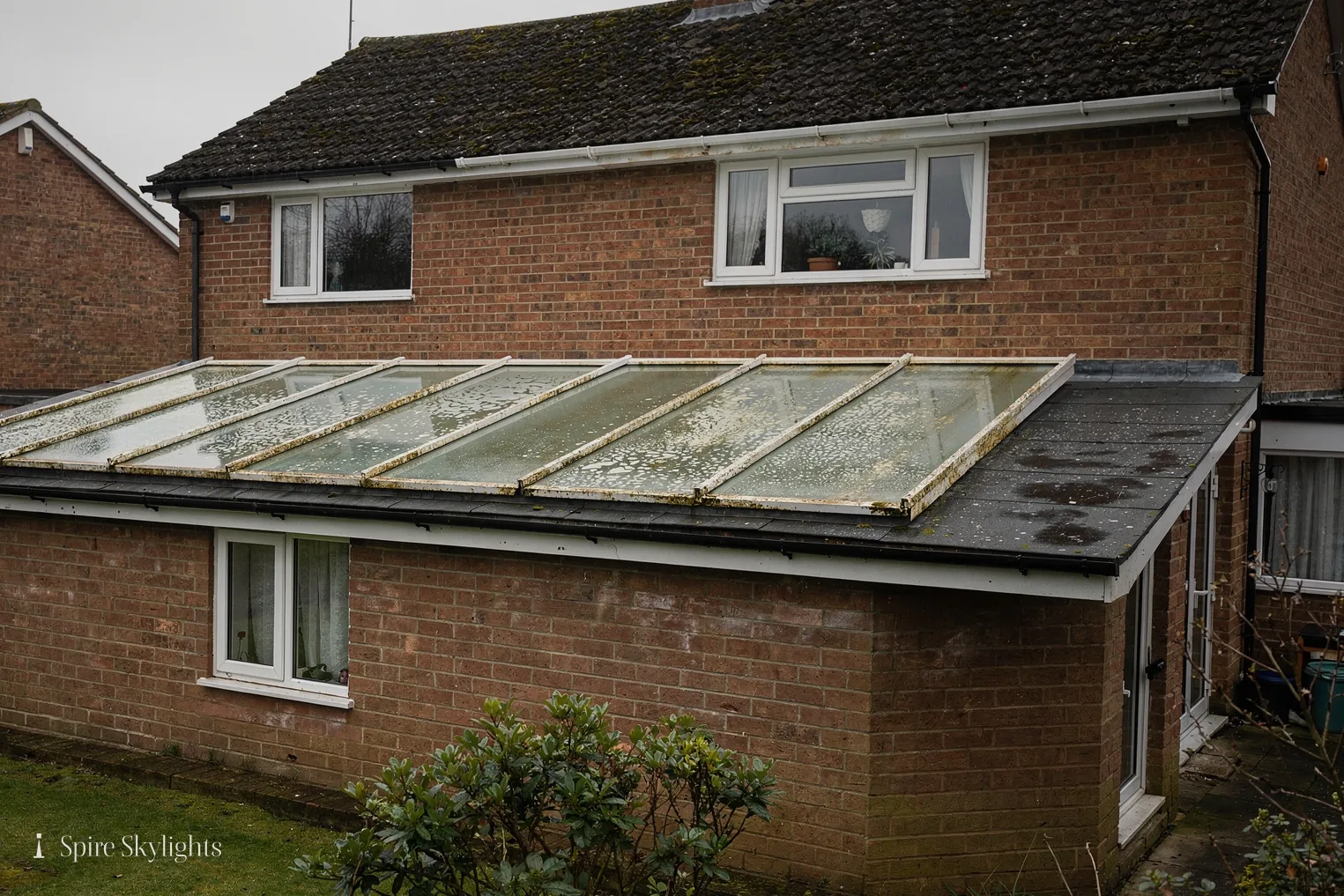
Old lanterns tend to give up in the same few ways: sealed units that have misted between the panes, perished seals, and frames that let the cold in. Where the kerb under an old lantern is level, sound and the right size, the new lantern can often go onto it, which keeps the work inside to a minimum. Where it is rotten, low or out of square, we rebuild it in the same visit and make good the lining inside.
Either way, the ceiling around the kerb is plastered and made good before we leave, so the room looks as if the new lantern had always been there.
Check the existing kerb for level, size and soundness
Confirm the planning and Building Control route
Lift out the old lantern and weather the opening
Fit, seal and weather the new lantern on the kerb
Make good the lining and the ceiling inside
The short version
Planning depends on the house. Building Regulations apply to every whole lantern, new or replacement.
08 Cost and the areas we cover
What sets the price of a lantern, and where around Coventry we fit them.
On the roof: what sets the cost
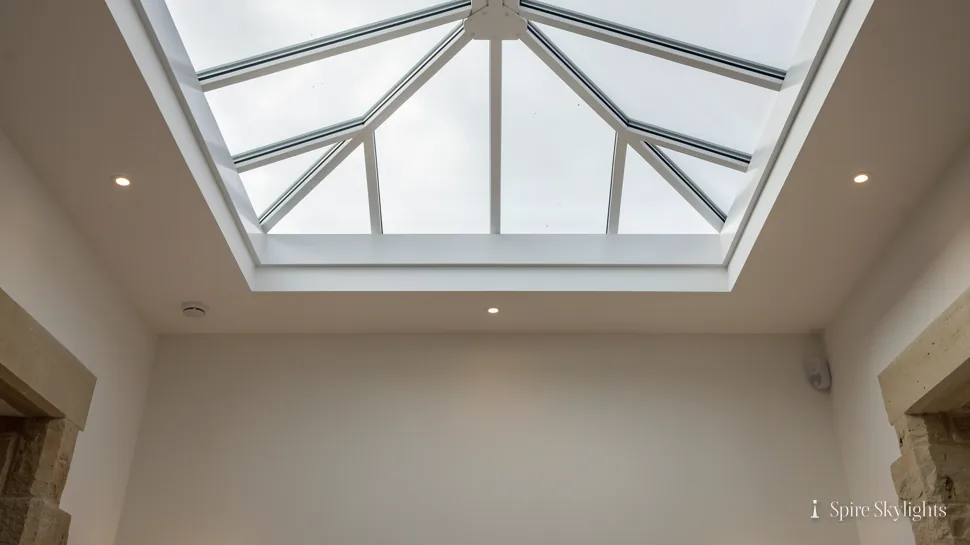
The cost of a roof lantern comes down to a handful of things you can see on the quote. The size and style of the lantern. The frame, aluminium or uPVC, and its colour. The glass: double or triple, solar control, self-cleaning. Any opening vents, and whether they open by hand or by motor. Then the roof work: a new opening with trimmers and perhaps a beam is a bigger job than a new lantern on a sound existing kerb, and access to the roof plays its part as well.
Inside, the lining, the splay, the plastering and the making good are part of the price, not extras added at the end. So is the Building Control notification where the work needs one.
We give you a fixed written quote after a free survey, with each of these items set out, before any work starts. Our guide to roof lantern costs explains each cost driver in more depth, and you can ask for a quote online whenever you are ready.
In the room: areas within 30 miles
We fit roof lanterns across Coventry and every town within 30 road miles of it. In the city that means extensions on the 1930s semis of Styvechale and Finham, the Victorian and Edwardian terraces of Earlsdon and Chapelfields, and the post-war houses of Tile Hill and Wyken. Further out it takes in Kenilworth, Warwick, Leamington Spa, Rugby, Nuneaton and Solihull, and on to Hinckley, Lutterworth and Stratford-upon-Avon.
The houses change as you travel, and so does the lantern that suits them. A Regency house in Leamington may sit in a conservation area or be listed, which shapes both the planning route and the style. A newer home in Rugby or Nuneaton with a large kitchen extension may have the roof depth for a generous splay. Our areas we cover page lists every town.
Wherever you live, the job runs the same way: a free survey at the house, a fixed written quote, the lantern fitted and sealed on the roof, and the room finished inside, with our 10-year workmanship guarantee on the work.
One survey, one fixed written quote, and a lantern finished on the roof and in the room.
Our 10-year workmanship guarantee: Ten years.
Workmanship guarantee on every installation
From opening to finished room
Day 1, morning
The opening is trimmed and the kerb fitted
Day 1, afternoon
Lantern set on the kerb, sealed and weathered
Day 2 or after
Plastered, made good and the room finished
Roof lantern questions
Do I need planning permission to install a roof lantern?
It depends on where the lantern goes. Permitted development lets rooflights go ahead without an application only where they project no more than 150 mm from the roof plane, and a lantern stands higher than that. On a new extension, the lantern is judged as part of the extension, under permitted development or the extension's own planning permission. Adding one to an existing flat roof usually needs an application to the council. Listed buildings need listed building consent, flats and maisonettes have no householder permitted development rights, and an Article 4 direction can remove those rights. We check the route for your house before we quote.
How much does it cost to install a roof lantern?
The cost depends on the lantern and on the roof under it. The size and style, the frame material and colour, the glass specification and any opening vents set the price of the lantern itself. The roof work matters just as much: a new opening cut into an existing roof, with trimmers or a beam, is a bigger job than a new lantern on a sound kerb. Lining, splaying, plastering and making good inside are part of the job too. After a free survey we give you a fixed written quote with every item listed, before any work starts, so you know the full cost from the outset.
How big can a new roof lantern be?
As big as the roof can carry and the maker can build. Each manufacturer sets a largest size for each style, and the lantern must sit on a kerb framed into the roof structure. On a new extension the builder can frame an opening for a large lantern from the start. On an existing flat roof the joists decide: a wide opening needs trimmers, and sometimes a beam sized by a structural engineer, all of which is Building Regulations work. Bigger is not always better inside, either, because the lantern has to sit well with the lights and the room. We measure the room and the roof together and suggest the size that suits both.
Can I fit a roof lantern to a sloping roof?
A lantern needs a level kerb, and a level kerb needs a flat roof. On a pitched roof the natural answer is a roof window set into the slope, or a conservation rooflight on an older house, both of which follow the line of the roof and bring in plenty of daylight. Where a roof has a flat section, such as the top of a rear extension or a flat area within a larger roof, a lantern can go there as long as the structure and the planning route allow it. At the survey we look at the whole roof and tell you which option gives the room the most light.
Can I install a roof lantern on an orangery or conservatory?
An orangery is built for one. Its roof usually has a flat perimeter with a lantern at the centre, and a new or replacement lantern sits on the kerb there in the same way as on any flat roof. A conservatory is a different case, because its roof is normally all glass or polycarbonate, with no flat area to build a kerb on. Turning a conservatory roof into a solid roof with a lantern is a structural change that usually needs Building Regulations approval, and the walls and foundations must be able to carry the new roof. We look at the frame and the roof at the survey and set out what is involved before quoting.
Are roof lanterns worth it, and will one add value to my home?
For a deep extension that is dark in the middle, a lantern is often the single change that makes the room work, because it brings daylight to the part that side windows cannot reach. Whether it adds value depends on the house and the local market, so nobody can honestly put a figure on it in advance. What buyers notice is a bright room with a lantern that is dry, clear and properly finished inside, and what puts them off is a misted, draughty or leaking one. A lantern that meets Part L, sits on a sound kerb and carries a 10-year workmanship guarantee is the kind worth paying for.
Read further on roof lanterns
Book your free survey
No obligation. We survey before we price.