Skylights & rooflights in Warwick
A county town's roofs, relit from above.
Warwick was rebuilt after a fire in 1694, sits on sandstone beside the Avon and the Grand Union Canal, and keeps timber-framed survivors at the edge of a centre otherwise made of late 17th and early 18th century brick and stone.
- Warwick District Council
- River Avon and canal
- County town, rebuilt 1694
A town rebuilt after the Great Fire of Warwick
Warwick is a market town, civil parish and the county town of Warwickshire, in the Warwick District, adjacent to the River Avon. It is 12.5 road miles from central Coventry and adjoins Leamington Spa and Whitnash. The 2021 Census gave it 36,673 residents. It has ancient origins and a range of historic buildings, notably from the Medieval, Stuart and Georgian eras, and the Grand Union Canal passes through the town.
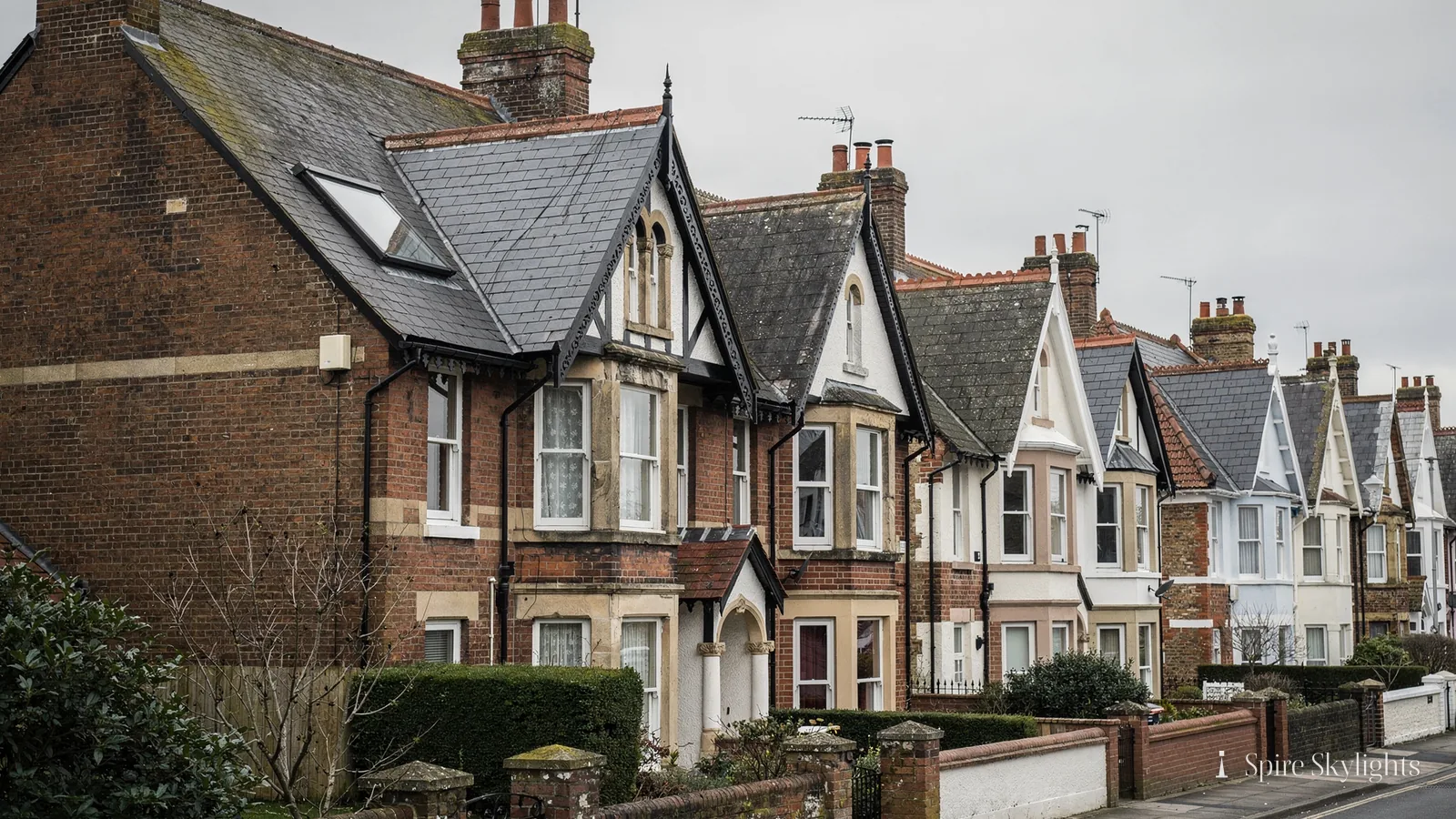
The first fact about its houses is fire. Much of the medieval town centre was destroyed in the Great Fire of Warwick on 5 September 1694, which in five hours destroyed 460 buildings and left 250 families homeless. As a result, most of the town-centre buildings are of late 17th and early 18th century origin. Some medieval timber-framed buildings survive, especially around the edges of the centre, and the Lord Leycester Hospital on the High Street, whose oldest parts date from 1383, is one of the notable examples.
The second fact is stone. Warwick was chosen as a site for the burh because the local outcrop of sandstone alongside the Avon offered a defensible position, a good source of water and building material. Castle Bridge, which consists of a single sandstone arch over the Avon, opened in 1793. Sandstone and brick are therefore part of the town's character, and the roofs above them are commonly tile or slate.
The third fact is water. The River Avon and the Grand Union Canal both pass through the town, and older outbuildings anywhere can be converted to living space. Hat making was one of the minor industries of the early 19th century, and Warwick was largely bypassed by the Industrial Revolution, so it kept its older stock rather than being rebuilt around heavy industry.
Today the town is a base for businesses, including National Grid's UK headquarters on Warwick Technology Park, and it sits on the M40 and the A46 trunk road. It also has two railway stations on the Chiltern Main Line. People who live and work here often want a home that suits an office day as well as an evening, and an improved roof is a good way to get that.
Warwick is joined to Leamington Spa and Whitnash, so a household can live in one and shop in another without noticing the boundary. For us that means the same survey routine covers all three, and a roof you see in Warwick has probably got a cousin a few streets away in Leamington.
The castle stood within a larger Anglo-Saxon burh, and the town walls were built close to its ramparts. For an owner who would rather improve the house they have than move, the roof is a good place to start. A rooflight is among the most considered ways of doing that.
Old brick, riverside conversions, flat backs: Warwick glass
Warwick has older brick and stone houses, converted riverside buildings and plenty of flat-roofed extensions behind them. Conservation rooflights, flat glass and lanterns each have a natural home here, and the choice depends on what the roof is made of. Outside, each is fitted and sealed; inside, the reveal is plastered and made good.
- Conservation rooflightsOn the town's older roofs, particularly near the centre, a slim flush unit keeps the roof line in keeping.
- Flat roof rooflightsA flat-roofed rear addition on a converted or older building is the right place for modern flat glass.
- Walk-on rooflightsA courtyard or a small terrace above a lower room can carry a walk-on panel that passes light down to the room below.
- Roof lanternsA converted outbuilding with a high ceiling suits a lantern, which adds height and daylight together.
Also fitted here
Near Warwick
- Leamington Spa8 min
- Whitnash9 min
- Radford Semele13 min
- Cubbington12 min
Drive times from Warwick town centre.
Listed, medieval and Georgian: the council's map comes first
The planning authority in Warwick is Warwick District Council. A town whose centre was rebuilt in the late 17th and early 18th centuries, and that holds buildings from the Medieval, Stuart and Georgian eras, needs careful checking. We look at each address before we quote, asking whether the building is listed, whether the street is in a conservation area and whether any direction applies. The definitive map of protected areas is held by the council, so we check against it and ask it to confirm.
Where a building is listed, consent is the first step. We lodge the Building Control notification where it applies, and the work follows the standards in force. Read the national rules in our rooflight planning guide. Planning an extension or a conversion as well? The council is the right place for those questions, and we will work from whatever drawings you have.
01 Rebuilt centres and edge-of-town timber
Brick, stone, tile and old timbers, and a roofline worth protecting.
On the roof
A house from the rebuilding after 1694 has a roof that was made by hand. The timbers are old, the spacing varies and the covering may be clay tile or slate that has been patched many times. When we open the roof space we learn more than any drawing tells us, so the survey starts with a torch and a tape measure.
The best rooflight for a roof like this is a conservation unit: a slim frame with one glazing bar, fitted flush with the covering. It follows the lines of traditional cast roof lights, and from the street it sits as quietly as a rooflight can. On the rear slope, out of sight, it is even less noticeable.
The covering is lifted in order, set aside and re-laid with new fixings, and the flashing is dressed to fit. Any cracked tile or slate is replaced from matching stock. If a rafter must be cut, new timbers are trimmed in around the opening to carry the load.
Timber-framed buildings, the survivors around the edges of the centre, need extra care. The frame is part of the structure and part of the character, and we do not touch it without a plan agreed with you and, where it is listed, with the council.
Where a building has a mix of old and newer sections, a rooflight in each part can be chosen to suit. The older section takes a conservation unit and the newer one a standard roof window, and from the lane the two look like part of one considered scheme.

In the room
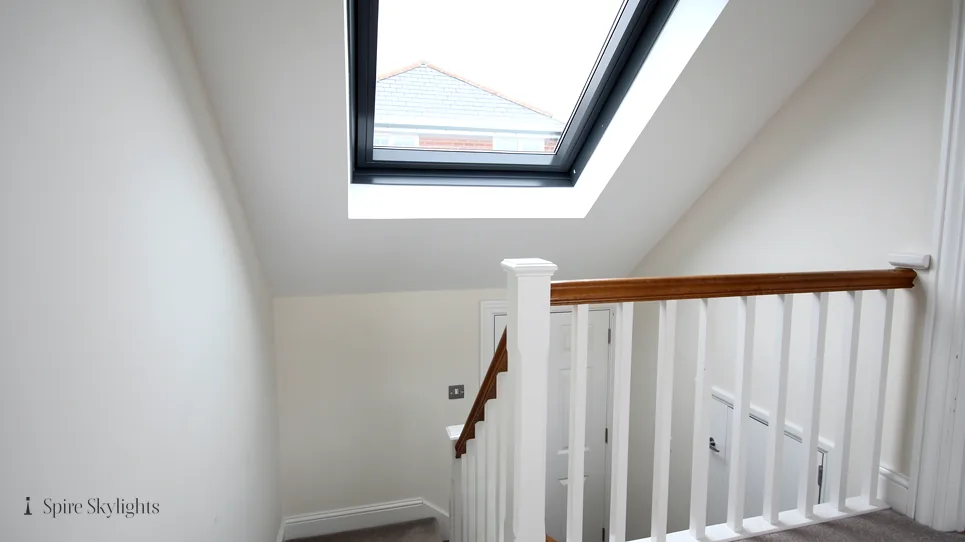
Inside an old Warwick house, ceilings and walls are rarely square. The plaster may be lath and plaster, patched in places and thick in others. We cut to a clean line, back to sound plaster, and build the reveal from insulated board. The skim carries across the join so old and new read as one surface.
A well-splayed reveal in a small attic room can change it completely. The slope of the ceiling carries the light down the wall, and the corner that was dark becomes the best seat in the room. We take the splay as wide as the roof depth allows.
Beams and other features stay protected throughout. If you have a favourite one near the opening, tell us at the survey and we will plan around it and note it in the quote.
For a top-floor room under an old roof, we often suggest a blind that matches the window frame. Sleeping in a room lit from above is lovely in summer and a little too bright at dawn, so a blind is a sensible companion.
When the plaster is dry, we run a hand along each edge, look at the line from the doorway and tidy any mark we find.
The short version
An old roof gives away its secrets slowly, so the survey is where the job is really decided.
02 Riverside conversions and flat-roof rears
Former workspaces turned homes, and the flat extensions behind them.
On the roof
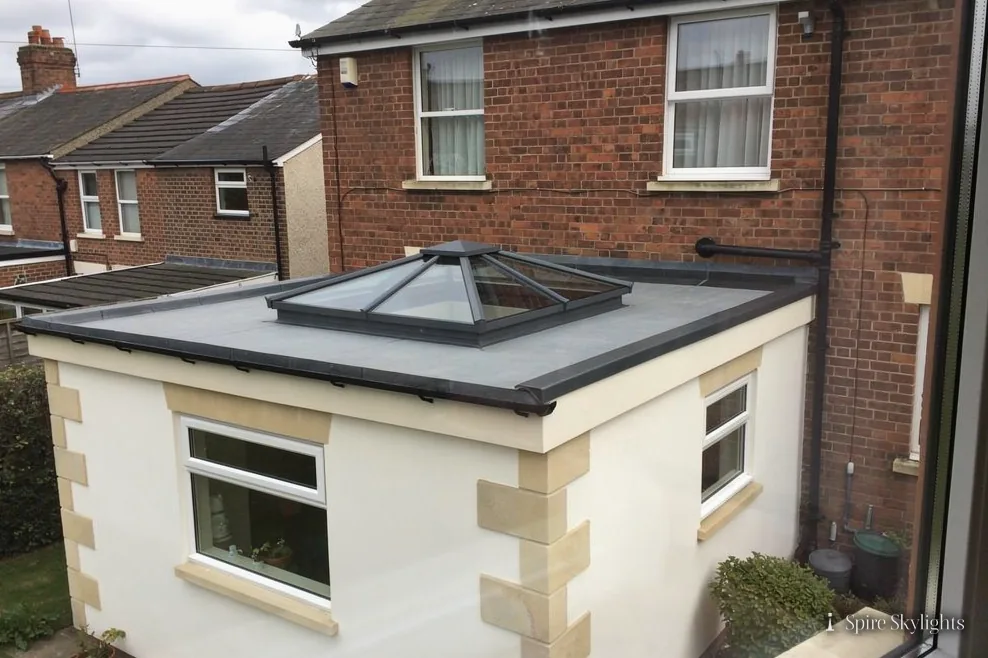
Where a building made for work has become a home, its roof often reflects the earlier use. Large spans, simple trusses and lean-tos at the back are common, and many have a flat or low-pitched section that has been patched with more than one covering. These are good places to put a larger rooflight, because the structure is often generous.
For a flat section, we check how the deck is holding up, which way water falls and how the edge is finished, then build an insulated upstand, lap the membrane up the face and fit the glass with a flashing over the top. If the roof surface needs renewing around the opening, the cost goes into the same written quote, because a new rooflight on a worn roof is a short-lived improvement.
Moisture is a fact of life near water. We choose frames with a thermal break and glass with good edge performance, and we detail the lining so condensation does not stain the plaster. Walk-on rooflights have a place too, where a yard or a small terrace sits above a lower room.
Every installation is held to current standards, our ten-year workmanship guarantee stands behind the fitting, and the quote itemises what is included.
For converted buildings with large open roofs, electric opening rooflights are worth considering. Warm air collects at the top of a tall space, and a unit that opens on a switch lets it out without ladders.
If a canal-side building has a neighbour tight against it, access is planned first, since a rooflight is only as good as the way it can be reached and flashed.
In the room
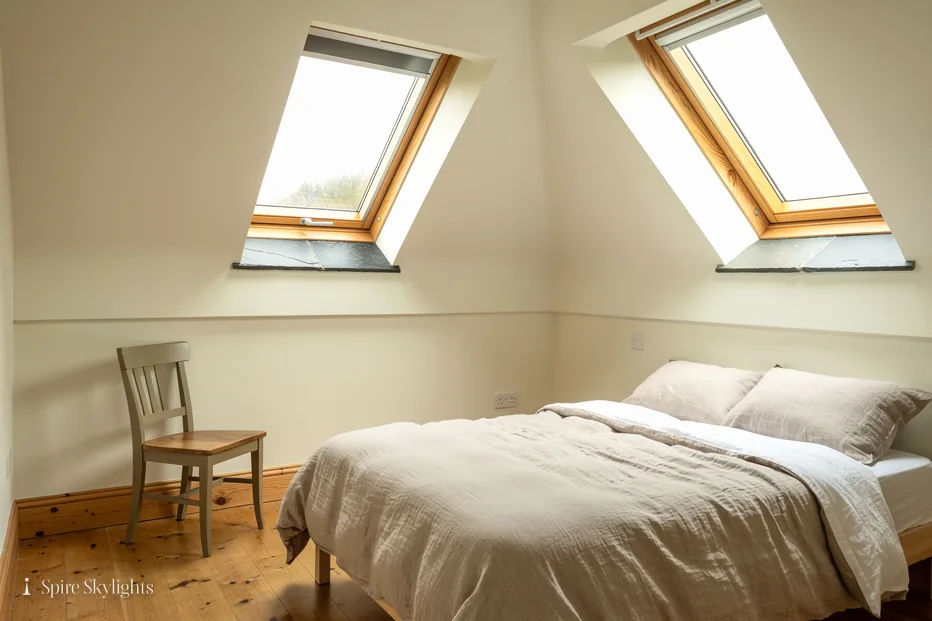
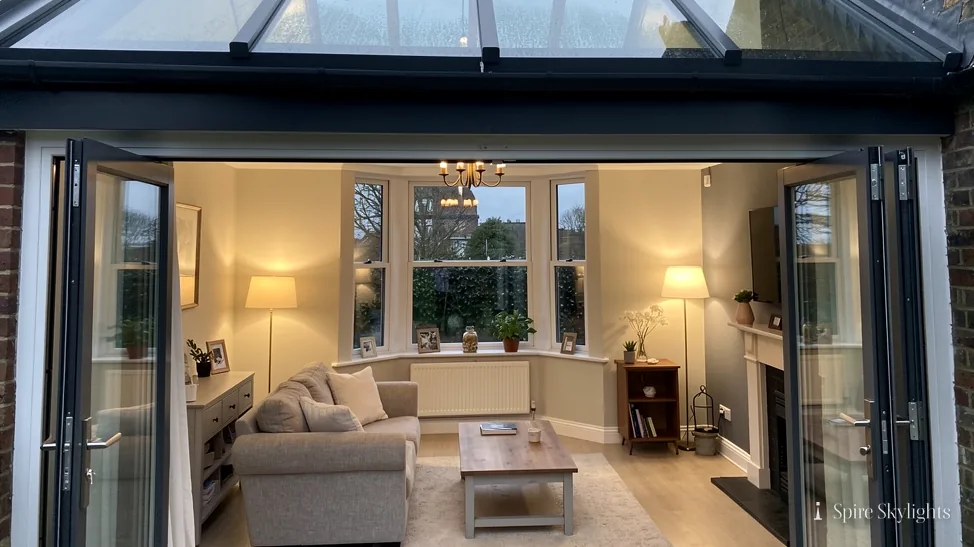
Inside a converted building, the new opening often becomes the centrepiece. A lantern over a living area draws the eye upward, and the plastered reveal around it should look like architecture. We use straight-edge beads and a hand skim to make the corners crisp.
In a flat-roofed extension, the room beneath is often the kitchen or the dining area. We position the rooflight with the layout in mind, away from the extractor and above the table, and angle the splay to send light where people sit.
A swept floor, wiped worktops and folded dust sheets mark the end of the job. We look up with you at the finished ceiling and make sure every edge is as you want it.
Cables for electric units, blinds and sensors are routed inside the roof space and hidden behind the plaster. Exposed brick and stone near the opening are protected from dust and splashes, and wiped clean at the end.
Free survey, fixed written quote and a booking date that fits your diary are the only three steps between a dim room and a bright one.
Buildings made for work have the spans to take the biggest, brightest rooflights.
Old town, riverside damp, arrival times: Warwick
My Warwick house is in the old town centre. Where do we start?
With your address. We check whether the building is listed and whether the street has extra protection, and we ask the council where there is doubt. If the house is listed, consent comes first. If not, we survey the roof, recommend a conservation unit and put the position and finish in the written quote. A photograph from the pavement helps us prepare.
Can a rooflight be fitted on a converted building near the river without damp problems?
Yes, with the right detail. We choose a frame with a thermal break and good glass, build an insulated upstand, seal the membrane and line the reveal so the plaster stays dry. The survey picks up how the roof sheds water, and any work to the roof surface is included in the quote. Walk-on panels can be used over courtyards.
How long does it take to get someone out to Warwick?
From the city, Warwick is roughly nineteen minutes by road, and surveys can often be booked within the week. Message us on WhatsApp with a photograph of the roof, or ring, and we will agree a time. The survey is free and the quote that follows is fixed.
We survey before we price.
Then we finish the room.
Free survey · Coventry and 30 miles around
Book your free survey
No obligation. We survey before we price.