The short answer
Yes, glass loses more heat than an insulated roof, so some rooflight heat loss is unavoidable. A modern double glazed unit with a low-emissivity coating, gas fill and a well-insulated frame loses far less than an old one, and its effect on the whole house is small. The fitting matters as much as the glass.
Where the heat goes
Glass is thinner and conducts heat more readily than an insulated roof build-up, so any rooflight loses more warmth per square metre than the roof around it. That is simply physics. What you control is how big the loss is. A single pane or a tired old double unit can feel like a cold patch above the room. A modern unit holds the heat in far better, and you stop noticing it.
Heat leaves through a rooflight in three ways: through the glass, through the frame and spacer bar around its edge, and around the opening if the surrounding insulation has gaps. A good specification deals with all three, not just the glass.
What cuts rooflight heat loss
A skylight can feel cold in winter for reasons that are easy to name and to fix:
- Low-emissivity coating. A thin layer on one pane reflects heat back into the room.
- Gas fill. Argon between the panes conducts less heat than air.
- Warm-edge spacer. A spacer bar in composite material, not bare metal, reduces loss round the edge of the glass.
- A thermally broken frame. A break in a metal frame stops heat running straight through it.
- Continuous insulation. The insulation of the roof or upstand should run right up to the frame, with no gaps.
- A third pane. It reduces loss further in cold or north-facing rooms. Our answer on whether a third pane pays off weighs that choice.
What the Regulations require
For an existing home, the Regulations cap the heat loss of new and replacement units by type. For a flat-roof rooflight or lantern the ceiling is 2.2 W/m²K. A pitched-roof unit, conservation styles included, is classed as a roof window and is capped at 1.4 W/m²K, with Window Energy Rating band B as the alternative. Taking out a whole unit is notifiable building work, and the new one must meet the cap for its type. A glass-only change in a sound frame is not a controlled fitting.
An old rooflight installed years ago was often built to a looser standard, which is why a replacement can make a visible difference to how a room feels.
Why the installation matters
A unit that tested well can still lose heat on the roof if it is fitted badly. The usual culprits are gaps in the insulation where the roof was trimmed, an uninsulated kerb or lining, and air leaking around the frame. Each creates a cold edge that chills the room and encourages condensation on the glass.
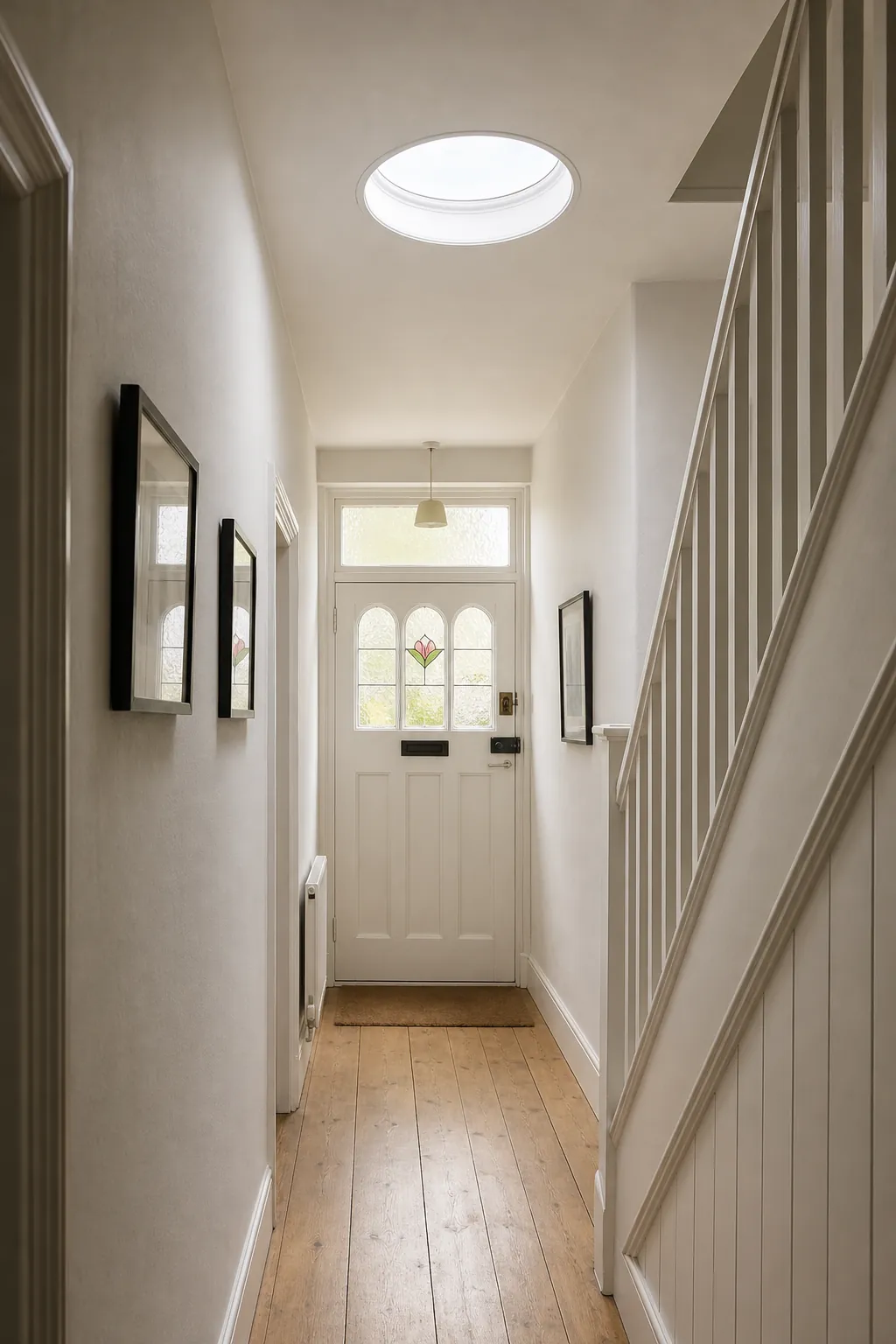
That is why we describe our work as finished inside and out. Outside, the unit is flashed and sealed with the insulation carried right up to the frame. Inside, the reveal is splayed where the roof allows, then finished in plaster. A warm, lined reveal keeps the surface near the glass close to the temperature of the ceiling, which you feel as comfort.
Condensation and the cold edge
The first sign of poor performance is often moisture. On a cold morning, water collects on the room side of the glass or along the lining, and in time it can stain the plaster or lift paint. This happens where a surface falls below the dew point of the room air. Kitchens, bathrooms and rooms with many people in them produce the most moisture, so they show it first.
Three things reduce it: a unit with a warmer inner surface, a reveal that is insulated and lined rather than bare, and some ventilation. An opening rooflight is a useful ventilator because it lets damp air out at the highest point of the room.
Is the loss worth worrying about?
For most roofs, a well-specified rooflight changes the heating picture only modestly, while bringing daylight into a room that needs it. Rooms that get more daylight tend to need less electric lighting through the day, and a bright room is easier to enjoy through a Coventry winter. If the room feels cold under your existing rooflight, the cause is usually an old unit, a failed seal, or gaps around the frame, and each can be addressed at the survey. A misted unit, for instance, has a failed seal, may have lost some gas fill and insulates less well, which our guide to what causes mist inside the glass explains.
Small checks you can make yourself
Before you call anyone, a few observations help us help you. Run a hand around the frame on a windy day and see whether you can feel moving air. Look for water between the panes, which signals a failed seal. Note whether the cold feeling is strongest at the glass or at the edges, because edge chill points to the frame and insulation rather than the pane. Photos of the room side and, if it is safe to see it from a window, the roof side, are useful to bring.
What we do at the survey
The free survey looks at the glass, the frame, the way the unit meets the roof and the room below. You then get a fixed written quote naming the unit, its energy figure and how it meets the Regulations. Where the work is notifiable we deal with Building Control, build to current Building Regulations and stand behind it with a 10-year workmanship guarantee.