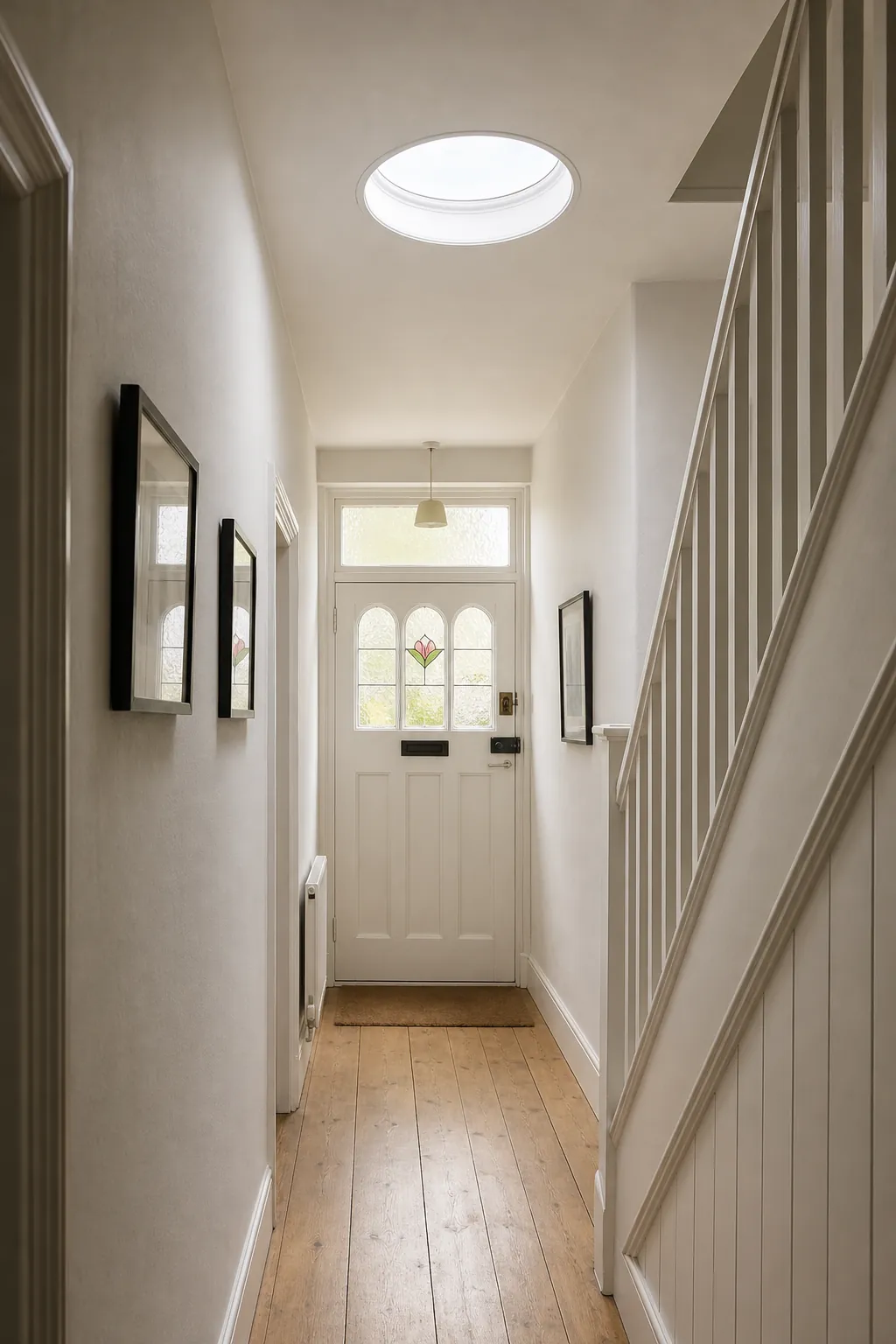
A room under a large piece of glass behaves differently from one with a wall window. The sun reaches it from above for more hours of the day, and the heat it brings has nowhere to go but into the room. Solar control rooflight glass is the specification that deals with that problem at the source, before the heat is inside. This guide explains how the coating works, which glass types are on offer, and how we decide whether a Coventry roof needs it. If you want the shorter question first, see our answer on whether rooflights make a room hot in summer.
What solar control glass does
Sunlight arrives as a mix of visible light, ultraviolet and infrared. The visible part is what you want in the room. The infrared part is mostly heat. A solar control coating is a microscopically thin layer, applied to one surface of one pane, that reflects or absorbs a share of the infrared and some of the visible light too, before it reaches the room side.
Two measurements describe the result:
- g-value (total solar energy transmittance): how much of the sun's energy gets through the unit as heat. A lower g-value means less summer heat.
- Light transmittance: how much visible light gets through. A higher figure means a brighter room.
The art of specifying the glass is choosing a pair of numbers that suits the room. Cut the g-value hard and you also lose daylight, which defeats part of the reason for the opening.
The glass types you will be offered
Makers describe their options in different words, but they fall into a handful of families:
| Glass type | What it does | Trade-off |
|---|---|---|
| Clear low-emissivity | Keeps heat in; admits most sun | Little protection from summer sun |
| Solar control coating | Reflects part of the sun's heat | Slightly cooler tone and less light |
| Tinted or body-tinted | Absorbs heat through the glass | Darker look; glass itself warms up |
| Self-cleaning coating | Breaks down and rinses off dirt | Does not control heat on its own |
Several of these can be combined in one sealed unit. A common pairing is a solar control coating on the outer pane with a low-emissivity coating on an inner one, so the unit rejects the sun's heat in summer yet still holds the room's heat in winter.
Why orientation changes the answer
Where the rooflight faces is the biggest single factor in whether you need solar control glass at all.
- South and south-west slopes take the strongest, longest sun. Solar control glass is usually worth specifying here, especially for larger units.
- East slopes catch low morning sun, which warms a bedroom early but rarely overheats it.
- West slopes catch the late afternoon sun, when the house has already stored the day's heat. They can be uncomfortable in the evening.
- North slopes receive mainly diffuse light and almost no direct heat. Solar control glass is rarely needed, and a coating here can darken a room that wants every bit of daylight.
The same glass can be right on one slope of a house and wrong on the other. We choose it unit by unit, not as a standard upgrade.
Size, pitch and what sits under the glass
The area of glass matters as much as its type. A large flat-roof rooflight or a roof lantern over an extension lets in a lot of sun, and a kitchen diner under it can warm up quickly. A small roof window above a landing does far less. The pitch matters too: a flat or south-facing slope meets the high summer sun close to square-on, while a steep north, east or west slope meets it at a glancing angle.
What lies beneath changes the experience as well. A room with a tiled floor and thick walls absorbs heat and releases it slowly. A lightweight extension with a lot of glazing heats and cools fast. We talk through the room's construction at the survey, because it affects how much of the glass specification you need to carry.
What to ask a supplier
The wording on quotes can hide a lot. If a rooflight is described only as "solar glass" or "heat-reflecting", ask for the detail behind it. A useful quote names the following, and a good supplier will give them without fuss:
- the g-value of the whole sealed unit, not just the coating;
- the light transmittance, so you can judge how bright the room will stay;
- which pane carries the coating, and whether a low-emissivity coating sits alongside it;
- the u value of the complete unit, frame included;
- whether the glass is toughened or laminated on the inner face, which matters for safety in a rooflight.
Comparing two units on a single number, whether g-value or u value, is how people end up with glass that suits the brochure but not the room. We set the figures side by side for you at the survey.
Solar control glass and winter warmth
A common worry is that a coating built to reject the sun will make the room colder in winter. In practice, the heat that matters most in winter is the heat leaving the room, and that is governed by the unit's u value, not by the solar coating. A good unit pairs both: low emissivity to keep indoor warmth in, and solar control to keep summer sun out.
There is a real trade, though. On a south slope in winter, clear glass gathers a useful amount of free warmth from low sun. A strong solar control coating gives a little of that up. For a room that is already too hot on spring and autumn afternoons, that is a fair price. For a cool north-facing room it would not be, which is why we do not treat the coating as a universal upgrade. The balance of heat in and heat out is explained further in our guide to rooflight u values and Part L.
Reading the room, not just the roof
The same Coventry street can hold a dozen different situations. A rear extension in Finham with a lantern over the dining table faces a very different sun from a loft bedroom in Foleshill with a small roof window on a north slope. A kitchen at the back of a Kenilworth semi, with a south-facing rooflight and a large patio door below, can overheat even with a good coating, because the sun enters from two sides. In a room like that, solar control glass is one part of a set of measures that includes ventilation and perhaps an external blind.
Equally, a study that gets sun only in the morning may never need more than clear low-emissivity glass. We would rather leave an unneeded coating off the quote than sell you a darker room to solve a problem you do not have.
Other ways to manage the sun
Glass is not the only tool, and it often works best alongside one of these:
- Blinds. Internal blinds soften glare and take some heat off, but the heat has already entered the room. External blinds are more effective because they stop the sun at the glass, though they cost more and need a fitting suited to the roof.
- Opening units. A rooflight that opens, whether by hand or by electric motor, lets hot air rise out of the room. Paired with a window or door at a lower level, it creates a flow of air that cools the space.
- Rain sensors. Where an electric opening unit is fitted, a sensor closes it when rain starts, so you can leave it ajar safely.
- Shading from outside. A tree, an overhang or a neighbouring gable can shade a slope for part of the day. We note these at the survey.
Building Regulations and overheating
Part O of the Building Regulations deals with overheating in new homes, and it influences how designers specify glazing on new builds. For an existing house adding or replacing a rooflight, the controlling standard is Part L, which sets the energy limit for the unit. The energy limit depends on the type of unit. Flat roofs and lanterns are held to 2.2 W/m²K, and a pitched-roof unit is treated as a roof window with a ceiling of 1.4 W/m²K, or a Window Energy Rating in band B. A solar control coating does not change which of those applies, but the unit you choose must still meet it.
A whole-unit swap is notifiable building work. A sealed unit that has failed, or simply suits the room badly, can be exchanged for a solar control one in a sound frame without a new notification, because that swap is not a controlled fitting. The survey tells us which route your job takes, and we deal with the Building Control notification where one is needed.
Safety glass and cleaning
Glass in a rooflight sits above people, so the inner pane is normally laminated, which holds together if it breaks. The outer pane is commonly toughened. That makeup is separate from solar control, and a coating can be added to either pane without changing the safety arrangement. Because rooflights are out of reach, a self-cleaning outer coating is a popular addition, and it combines well with solar control. It reduces the need to climb onto the roof, though it does not remove dirt entirely in dry weather.
How we specify it for a Coventry house
The free survey covers which way the slope faces, how big the opening is, what sits beneath it and what shades it. We then recommend the glass that fits those facts and explain why, so the choice is yours with the reasoning in front of you. The quote that follows is fixed and written down before work starts, with the glass specification listed line by line.
On the day, the new unit goes in with its flashing and seals on the roof. Inside, the reveal is splayed if the roof depth permits and finished in plaster, which also helps light spread across the room. Everything is built to current Building Regulations and sits under our 10-year workmanship guarantee.
If the room already has a rooflight that overheats, we can look at whether a new glazed unit in the existing frame is enough, or whether the whole unit should be replaced. Our guide to choosing between new glass and a new unit sets out how that decision is made.
Whatever the glass, the aim is a room you want to sit in all year. If you are unsure after reading this, the survey costs nothing, and we would rather walk the room with you than guess from a drawing.