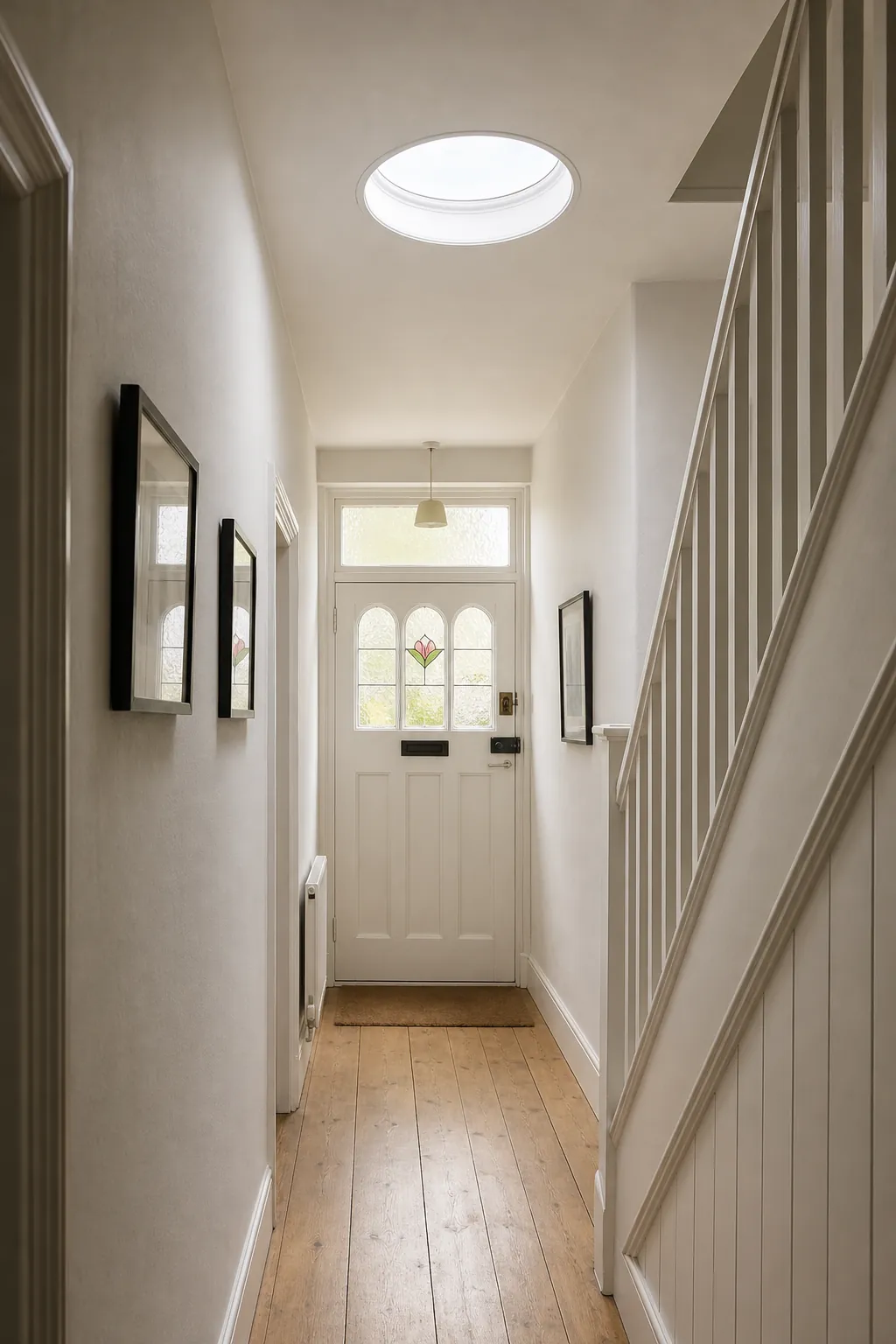
If you are searching for what a skylight costs in Coventry, the honest first answer is that the unit is only part of the bill. The rooflight or roof window itself, the opening it sits in, the way the roof is built, the access to get to it and the finish inside the room all add to the total. We do not publish price lists, because a figure quoted without seeing the roof would be a guess. What we can do is explain what drives the number, so that the written quote we give you after a free survey makes sense at a glance.
What you are actually paying for
A rooflight job has four parts, and a fair quote names each of them. First comes the unit: the glass, the frame, any opening mechanism and the flashing or upstand that ties it to the roof. Second comes the labour on the roof, which covers lifting out an old unit or forming a new opening, framing it, fitting the new unit and weathering it into the surrounding covering. Third comes the work inside: lining the opening, splaying the reveal where the roof depth allows, plastering and making good. Fourth comes the paperwork, which for notifiable work means the Building Control notification and the completion certificate at the end.
Quotes that list only a unit price leave the other three parts to be discovered later. A quote that lists all four lets you compare like with like, whoever you ask.
The factors that move the price
These are the questions we answer at the survey, roughly in the order they affect the total.
| Factor | Pushes cost up when | Pushes cost down when |
|---|---|---|
| Type of unit | Large, bespoke or lantern-style | Standard roof window size |
| Replacement or new | A new opening needs structural trimming | Same-size swap in a sound opening |
| Roof build-up | Thick insulation or complex covering | Simple, accessible pitched roof |
| Access | Scaffold tower or crane needed | Ladder or low eaves reach |
| Finish inside | Deep splayed reveal and decoration | Minimal lining only |
No single row decides the quote. A standard roof window swapped into an existing opening is the simplest case. A large bespoke rooflight over a new opening in a flat roof, with a scaffold and a plastered splay inside, sits at the other end. Most jobs land in between, which is why the survey matters more than any online calculator.
Rooflight or roof window: the unit itself
The type of unit sets the base of the price. A roof window in a pitched roof is a factory-made product built in a range of standard sizes, so the unit is a known quantity and the work is predictable. A flat rooflight over a flat roof is often made to the opening, with an upstand kerb that must be built or adapted. A roof lantern, with its raised glazed form, is usually made to measure and carries the most unit cost of the three. Glass specification also matters: solar control coatings, toughened or laminated inner panes, extra glazing layers and self-cleaning surfaces each add something to the unit.
If you are comparing a lantern with a flat unit for an extension, our guide on what a roof lantern costs to fit goes into that side of the question in detail.
Replacement versus a new opening
Replacing an existing unit is usually the lower-cost route, because the opening already exists and has already been framed. The old unit comes out, the opening is checked, the new unit goes in and the weathering is rebuilt around it. A new opening is a bigger job. A section of roof covering has to come off, rafters or joists are cut and trimmed with new members to carry the load, insulation is reinstated around the frame and the covering is tied back in. The structural work is what raises the cost, not the glass.
The size match matters too. Where a new unit is the same size as the old one, the existing opening usually serves. Where it is larger or a different shape, the roof structure has to change, and the price follows. We say which case applies at the survey, before any figure is written down.
Roof type, build-up and access
The same rooflight costs different amounts to fit depending on the roof around it. Clay or concrete tiles have to be lifted and relaid accurately around the flashing. Slate needs careful handling and sometimes new fixings. A single-ply or built-up flat roof needs the new kerb integrated into the waterproof layer. Deep insulation in a modern roof means a deeper reveal inside and a more careful junction with the vapour control layer.
Access is the factor people forget. A single-storey rear extension can be reached from a ladder and a working platform. A third-floor roof window over a terraced street may need scaffold or a tower, and a lantern too big to carry by hand may need lifting equipment. Where access needs equipment, it is a line in the written quote rather than a surprise on the day.
The unit is the part you can see in a brochure. The opening, the access and the finish are the parts that decide whether a quote is complete.
The finish inside the room
Many quotes stop at the roof. Ours do not, because a rooflight that leaves a raw hole in the ceiling is not finished. Roof depth permitting, we splay the reveal so the light spreads into the room instead of dropping straight down a tunnel. The lining is plastered and made good, ready for decoration. A deep, splayed and plastered reveal costs more than a simple lining, and it is the detail that makes the unit look like part of the house rather than something added to it.
If the room is freshly decorated, say so at the survey. We plan the protection and the making good around that, and the quote reflects it.
Regulations, notification and why they are in the quote
Replacing a whole rooflight or roof window is building work, and so is forming a new opening. The new unit has to satisfy Part L. In an existing home the target for a roof window is Window Energy Rating band B or 1.4 W/m²K, while flat-roof rooflights and lanterns are held to 2.2 W/m²K. Anything in a pitched slope, conservation units included, is treated as a roof window. Re-glazing a sound existing frame sits outside these controls.
Where the work is notifiable, we handle the Building Control notification and the completion certificate, with the council's own team or a registered building control approver. That time is part of the job rather than an extra you chase yourself. What an inspector looks for is set out in our Building Control answer for rooflights.
How our fixed written quote works
After a free survey, you receive a fixed written quote before any work starts. It lists the unit, the work on the roof, the work inside and the regulatory side, and it states what is included. The figure in it is the figure you pay for that scope. If you change the specification, for example by choosing a different glass or a larger unit, we re-quote in writing and you decide.
Because the quote is fixed, you can set it alongside others. Check that each names the same unit size, glass specification, finish inside and notification. Where one leaves out the plastering or the notification, the difference in price is the difference in scope, not a saving.
Brands, sizes and the range of choice
Many pitched-roof jobs use a VELUX roof window, because the standard size codes make replacement straightforward: the code on the old unit tells us what will fit the existing opening. Other makers supply flat rooflights, conservation rooflights and lanterns, and some work is specified from a manufacturer's own range. The brand is less important to the final figure than the size, the glazing specification and whether the unit opens. A fixed unit is simpler than one that opens by hand, and an electric opening unit adds the motor, the controls and the wiring to the list.
Opening units are worth thinking about early. A rooflight over a kitchen, bathroom or loft room that can open gives ventilation as well as light, and that often settles the choice before price comes into it.
Rooms and roofs that need extra thought
Some situations add cost in ways people do not expect. A conservation rooflight, made to sit flush with the roof covering, is a more specialised unit than a standard roof window. A walk-on rooflight over a basement or terrace is specified by the manufacturer's stated load rating, and the structure under it has to suit. A house with a shared party wall, a steep pitch or a roof that has been altered before may need extra investigation at the survey. None of these is a reason to avoid the work. They are reasons to have the roof looked at before anyone quotes.
Ways to keep the cost sensible
- Keep the new unit to the size of the old opening where the light is already good enough.
- Choose a standard roof window size over a bespoke one when the room allows.
- Do several openings in one visit, so access equipment and scaffold are shared.
- Decide the glass specification before the survey, or ask us to explain the options.
- Think about the room first: a rooflight placed where the light is needed does more than a larger one placed badly.
What we advise against is choosing on the lowest unit price alone. A unit that does not meet Part L, or an install without proper weathering, costs far more to put right than it saves.
Planning is a separate question
Cost and permission are different matters. Most rooflights on a house fall under Class C permitted development, but flats, listed buildings, Class Q barns and homes under an Article 4 direction or a restrictive condition are exceptions, and a planning application would add time and fee to the project. We check this before we quote, and the details are in our planning guide for Coventry.
What happens at the survey
The survey is free and there is no obligation. We look at the roof and the room, measure the opening, check how the roof is built, note the access and talk through what you want the space to feel like. Then we write the quote. If you want to book one, you can ask for a survey and quote and we will arrange a time that suits you. Our work carries a 10-year workmanship guarantee, and the unit carries the maker's separate warranty, and the quote sets out its terms.