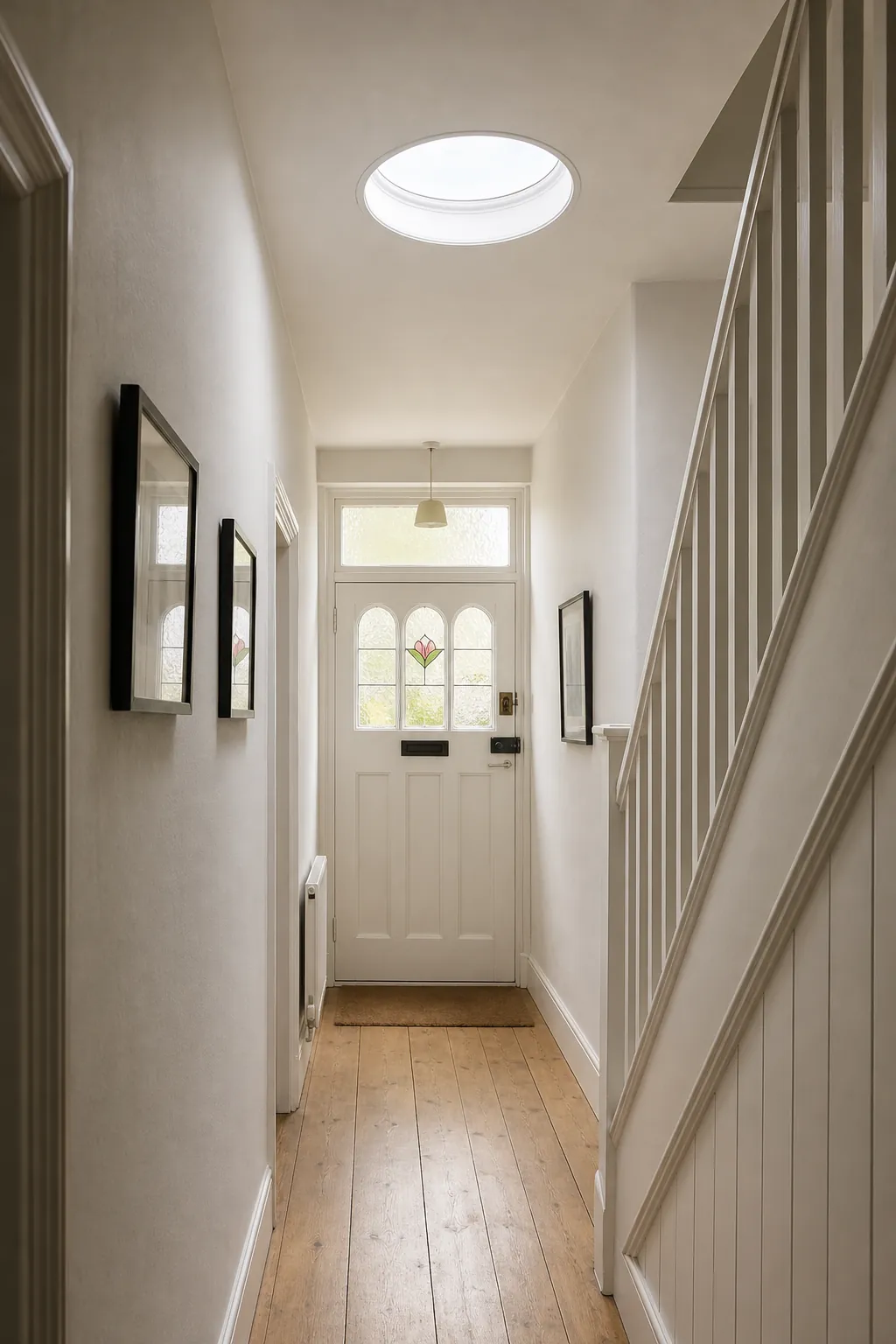
The short answer
Standard walk-on glass is clear, so yes, people can see through it in daylight and the room below can be seen from above when it is lit. If you want privacy, the glass can be specified with a frosted, etched, patterned or tinted treatment that blurs what can be seen while still letting light through. We choose that finish with you at the survey.
Clear glass in practice
The question of walk on rooflight privacy comes up on almost every survey. Clear laminated glass lets you see through it much as you would through a window. Looking down from a terrace, you can see the room below. Looking up from the room, you can see the sky, and anyone standing on the glass.
Daylight changes the picture. In the day, a bright terrace and a darker room mean the view upwards is clearer than the view downwards, which mostly shows reflections. At night with the room lit, the position reverses and the room shows from above. It is worth picturing both before you choose.
Obscure walk on glass: the options
Several finishes reduce what can be seen. Each affects the light that reaches the room, and each has a particular look.
- Fired-on pattern or dots. A ceramic pattern fused to the glass breaks up the view and also gives grip underfoot.
- Etched or sandblasted face. The surface becomes satin, so shapes blur into soft forms.
- Frosted or translucent interlayer. One of the bonded layers inside the glass is translucent, giving even diffusion.
- Tinted glass. A tint cuts glare and the clarity of the view in strong light.
Some makers also offer glass that changes from clear to obscure on demand. Availability and performance vary by system, so we confirm what a manufacturer actually offers for the size you need, instead of promising a feature in the abstract.
The trade-off with light
More obscurity usually means less transmitted light. A lightly etched panel keeps most of the brightness and softens the view. A heavily patterned or tinted one gives more privacy and reduces what reaches the room. The best choice depends on how dark the room is, how public the glass is and how much you value the clear view of the sky.
At the survey we hold samples against the real opening so you can judge the balance in the room it is meant for. A finish that seems plenty obscure in a showroom can look quite different in a bright terrace or a dark basement.
Where privacy matters most
Three situations come up again and again.
- A pavement or front-garden panel above a basement, where passers-by are close.
- A terrace panel above a bedroom or bathroom, where the room below needs to stay private.
- A first-floor landing panel above an entrance hall that visitors cross.
In each, an obscured finish is usually the right starting point. Where the glass sits over a room with no privacy need, such as a utility space or a plant room, clear glass can be left clear for maximum light. Our guide to walk-on rooflights for terraces and basements covers how the two situations differ.
Privacy and the rules
A rooflight facing the side of a house has to be obscure-glazed, and fixed shut anywhere under 1.7 m above the floor, to stay within permitted development. That is a Class C condition for rooflights in a roof slope, and it is checked as part of the planning picture. A flat or maisonette has no householder permitted development, and on a house an Article 4 direction can take the right away, so each property is checked. Our planning guide explains the tests.
Seeing it from both sides at the survey
Privacy is easiest to judge with your own eyes. At the survey we stand a sample over the opening, or as near as the site allows, and look at it from above and from below. One of us stands on the terrace while the other stays in the room, and we swap. It takes a few minutes and answers most of the questions that a data sheet cannot.
Time of day matters, so we ask when the space is used most. A room that is busy in the evening with the lights on behaves differently from one used mainly at midday, and the finish that suits one may feel too clear or too dull for the other.
Artificial light in the room is worth considering too. Downlights around the opening, a pendant beneath it or a bright kitchen all change how much of the room can be read from above after dark. A softer finish, or a change to the lighting layout, often solves it without having to darken the glass.
Finally, think about the view you want. A lightly obscured panel can still let you enjoy the movement of clouds and the changing colour of the sky, without the sense of being looked at. That balance is a personal one, and samples are the best guide.
What we fit and finish
Whichever finish you choose, the unit is fitted, flashed and sealed on the roof or terrace, and the opening is splayed where the depth allows, plastered and made good in the room. The finish you choose is written into our fixed quote, the work meets the Building Regulations in force and is backed by our 10-year guarantee on workmanship. See the walk-on rooflights service, or ask for a free survey and we will bring samples to look through.